Institutions are using Bitcoin across four broad areas: payments and settlement, collateral and lending, treasury reserves, and programmable financial products such as tokenized assets and structured strategies.
Each serves a different purpose and comes with a different set of operational questions. A treasury team considering Bitcoin as a reserve asset will think about custody, governance and accounting. A lender will care about collateral management and liquidation risk. A payments company will be more focused on settlement, compliance and integration. An asset manager exploring programmable finance will need to assess smart contracts, bridge architecture and the legal structure of the underlying product.
This guide is a primer on those four use cases, how they differ, and how institutions are beginning to put them into practice.
Why institutions are looking beyond simply holding Bitcoin
For much of Bitcoin’s institutional history, using it meant buying it, putting it into custody and holding it on a balance sheet. Indeed, that remains an important use case, and for some institutions it will remain the only one that makes sense.
But the conversation is getting broader.
As institutional custody, lending and settlement infrastructure has matured, companies have gained more options for how Bitcoin can fit into their financial operations. A treasury can hold BTC as a reserve asset, but it can also decide whether to use part of that position as collateral. For example, a payments company can use infrastructure connected to Bitcoin without denominating every transaction in BTC. An asset manager can explore tokenized credit or structured strategies built on smart-contract networks linked to Bitcoin.
That said, this does not mean every institution should be doing more with its Bitcoin. It means the range of choices is expanding.
Providers such as Fireblocks, Fordefi, Utila and Cobo now give institutions access to digital-asset infrastructure through systems designed around governance, policy controls, approvals and reporting. At the same time, lending markets, stablecoin settlement and tokenized assets have all become more sophisticated.
The institutional question is therefore changing. It is no longer only whether an organization should own Bitcoin, but what role Bitcoin should play once it becomes part of the financial stack.
The four institutional Bitcoin use cases at a glance

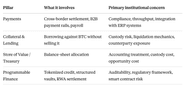
1. Payments and settlement
Bitcoin’s original financial use case was the movement of value. In an institutional setting, however, payments are about much more than sending an asset from one address to another.
Businesses need settlement infrastructure that can work with compliance systems, accounting software, treasury processes and existing enterprise workflows. They also do not necessarily want to denominate every transaction in Bitcoin.
Stablecoins on Bitcoin-secured infrastructure
That distinction is important because using infrastructure connected to Bitcoin does not always mean paying in BTC. Increasingly, institutions are using Bitcoin-secured networks to settle other digital assets, including stablecoins, while retaining the programmability and transparency of blockchain-based infrastructure.
Paystand’s USDb is one example. Paystand issues the dollar-backed stablecoin on Rootstock for business use cases including accounts receivable, accounts payable, payroll and treasury operations. Paystand has processed more than $20 billion in payment volume across a network of more than one million businesses, and USDb extends that model onchain, including through Bitwage, its cross-border payroll platform.
In fact, the more interesting development here is not simply that digital value can move quickly. That has been true for years. It is that blockchain-based settlement can increasingly fit into familiar business processes: invoices, payroll, treasury and enterprise payments.
For institutions, adoption becomes much more practical when new infrastructure can connect to systems they already use rather than forcing finance teams to rebuild their workflows from scratch.
Payments are also one of the areas where regulatory obligations are most immediate. Depending on the jurisdiction and product, institutions may need to consider money-transmission rules, stablecoin regulation, KYC and AML requirements, transaction monitoring, accounting, reconciliation and settlement risk.
While the technology may be new, the operational expectations around compliance, accounting and risk management are familiar to any institutional finance team.
2. Bitcoin as collateral
Institutions have traditionally treated holding Bitcoin and accessing liquidity as separate decisions. Until recently, if an institution needed cash, selling part of its BTC position was the obvious option.
Bitcoin-backed lending creates another route.
Instead of selling the asset, an institution can pledge BTC as collateral and borrow against its value. That allows it to access liquidity while retaining exposure to the underlying Bitcoin, although it also introduces risks that do not exist with passive holding.
Loan-to-value ratios matter. So do liquidation thresholds, the volatility of the collateral, custody arrangements and the legal structure of the loan. Institutions also need to understand who controls the collateral, what triggers liquidation and what happens if a counterparty or protocol fails.
In that sense, institutional Bitcoin lending increasingly resembles traditional collateralized credit. The underlying financial logic is familiar; the asset and infrastructure are different.
How institutions access Bitcoin-backed lending
Rootstock Institutional is one example of how this market is developing. The initiative connects institutional participants with Bitcoin-native lending and liquidity infrastructure, including protocols such as LayerBank, Midas and Solv. Institutional wallet and custody providers including Fireblocks, Fordefi, Utila and Cobo also integrate with the Rootstock ecosystem.
That matters because custody has historically been one of the largest barriers to institutional participation in onchain finance. An organization may be comfortable using Bitcoin as collateral, yet uncomfortable transferring that Bitcoin into an opaque structure with limited governance or visibility.
In turn, the newer model gives institutions more ways to interact with onchain financial products through custody systems, approval processes and controls that resemble the infrastructure they already use.
Even so, that does not eliminate counterparty risk or smart-contract risk. It simply gives institutions more options for how institutions manage those risks.
Bitcoin-backed lending and Bitcoin yield are different things
Commentators often discuss these categories together, but they deserve separate treatment.
Bitcoin-backed lending uses BTC as collateral to access liquidity. Bitcoin-denominated investment strategies, by contrast, deploy BTC into strategies designed to generate additional returns.
The objectives are different, and so are the risks.
Midas’s mHyperBTC is an example of the second category. The product tracks a BTC-denominated, market-neutral strategy that Hyperithm, a digital asset manager based in Tokyo and Seoul, manages. According to Midas, its broader platform has issued more than $1.7 billion in assets and distributed more than $37 million in yield.
Ultimately, the point is not that institutions should automatically seek yield on Bitcoin. Many will decide that the additional risk is not appropriate for their mandate.
What matters is that Bitcoin can now play several different roles inside an institutional portfolio. Institutions can hold it as an asset, pledge it as collateral or, in some cases, deploy it as part of a structured investment strategy.
3. Bitcoin as a treasury reserve
Treasury is the most familiar institutional Bitcoin use case.
An organization acquires BTC and holds it on the balance sheet as a long-term reserve asset, a diversification position, a macro hedge or an allocation to an emerging monetary asset.
The concept is simple. The implementation is not.
What treasury implementation requires
Once an institution begins holding meaningful amounts of Bitcoin, it has to decide how to structure custody, who has authorization to move funds, what approval processes it needs, how to account for the asset and how the position fits into the organization’s wider risk framework.
Naturally, those questions become more important as the size of the holding grows.
They also create a second layer of treasury strategy. Some institutions will decide that Bitcoin should remain entirely passive, with no lending, smart-contract exposure or additional financial use. Others may decide that a portion of their holdings can support liquidity, collateral or other strategic objectives.
From passive reserve to active strategy
That is why institutions increasingly understand treasury allocation as an entry point into institutional Bitcoin rather than a single fixed strategy.
Still, the distinction between holding Bitcoin and managing a Bitcoin treasury is important. Buying BTC is an allocation decision. Building governance around custody, liquidity, reporting, collateral use and risk is a broader treasury function.
RootstockLabs’ work with Animoca Brands Japan is one example of that shift. The collaboration explores Bitcoin-native treasury infrastructure for Japanese corporations, with an emphasis on governance, risk management, regulatory alignment and enterprise-ready financial tools.
The relevant question is no longer simply whether a company should hold Bitcoin. It is what role Bitcoin should play once it sits on the balance sheet.
For some organizations, the answer will remain straightforward: hold it securely and do nothing else. For others, Bitcoin may become part of a wider financial strategy involving collateral, settlement or programmable products.
Either way, both approaches can be rational. The appropriate choice depends on mandate, risk tolerance and operational capability.
4. Programmable Bitcoin finance
Programmable finance is the broadest of the four categories because it expands Bitcoin’s role beyond being an asset that institutions hold, transfer or pledge.
Smart-contract infrastructure connected to Bitcoin can support tokenized credit, real-world assets, structured investment products, automated strategies and stablecoin settlement. In those models, the financial asset may be familiar, while the infrastructure that issues, transfers or manages it changes. This is an important distinction.
Tokenization is not necessarily about inventing entirely new asset classes. Private credit, bonds and funds already exist. The opportunity is often to change the infrastructure beneath them: how institutions issue, transfer, settle and track those assets, and how easily they can interact with other financial applications.
For institutions, that can improve transparency and make certain processes easier to audit. At the same time, programmable finance introduces new technical risks. Smart contracts can contain vulnerabilities, bridges can fail, governance can be weak and economic assumptions can break down under stress.
As a result, an institution evaluating programmable Bitcoin finance needs to understand more than the product itself. It needs to understand how assets move between systems, where control sits, which components depend on trusted parties and what risks exist outside Bitcoin’s own consensus layer.
Tokenized real-world assets
Mercado Bitcoin offers a useful example. The Latin American digital asset platform has been tokenizing real-world private credit on Rootstock, expanding from an initial $20 million initiative and targeting significantly greater issuance.
https://www.linkedin.com/feed/update/urn:li:activity:7490015629471670272
The underlying asset is not new. Private credit already has an established market. What changes is the infrastructure that represents ownership, settles transactions and potentially connects those assets to other financial applications.
That is where tokenization becomes relevant to institutions. Instead, the opportunity is less about replacing traditional finance outright and more about improving parts of the infrastructure that supports it.
Structured Bitcoin strategies
Structured vaults are another example. Mellow Protocol and Tyr Capital have worked on institutional Bitcoin vault infrastructure on Rootstock using smart contracts to define how the vault deploys capital.
Rather than relying entirely on offchain processes, the protocol can encode parts of the strategy into transparent rules that anyone can inspect and audit.
Nonetheless, this does not remove investment or operational risk. It changes the form those risks take.
An institution may gain greater transparency around how a strategy works, while taking on additional smart-contract exposure. An institution has to assess that trade-off the same way it would assess any other financial infrastructure.
Why rBTC matters
Programmable finance requires a way for Bitcoin to interact with smart contracts.
On Rootstock, rBTC, the network’s native asset, plays that role. Rootstock pegs rBTC 1:1 to BTC and uses it to pay transaction fees and interact with smart contracts on the network. BTC moves between Bitcoin and Rootstock through the PowPeg mechanism.
This architecture differs from conventional wrapped-Bitcoin models that rely on a single centralized custodian to hold BTC and issue a corresponding token on another network. Rootstock instead uses a distributed bridge architecture that reduces reliance on any one custodian.
However, that distinction does not make the bridge risk-free. No bridge is. It does, however, change the trust model that institutions need to evaluate.
Rootstock is also EVM-compatible, which means developers can use many of the same development tools, smart-contract standards and auditing practices that the Ethereum ecosystem has already established.
For institutions, that familiarity can matter. Engineers do not have to adopt a completely new technical stack, and security teams can work with tooling and programming models they already understand.
Why the underlying security model matters
All four use cases eventually lead to the same question: what exactly are institutions trusting?
Bitcoin is attractive in part because institutions understand its monetary policy and proof-of-work security model well. Once BTC begins interacting with bridges, lending markets, smart contracts, stablecoins or tokenized assets, the trust model becomes more complex.
Institutions therefore need to assess both the relationship to Bitcoin and the additional infrastructure introduced on top of it.
What secures Rootstock
Rootstock uses merge-mining, which allows Bitcoin miners to secure Rootstock while continuing to mine Bitcoin. In 2026, more than 84% of Bitcoin’s hashrate has participated in securing Rootstock through merge-mining. Rootstock has also been operating continuously since its mainnet launch in January 2018.
For an institution, that operating history can be as important as the architecture itself. Teams will look at how long the network has been live, how much activity it has processed, how it behaves under periods of market stress, how concentrated its critical components are, how its bridge works and how the network governs upgrades.
In practice, these are more useful questions than asking whether a network is simply “secure.”
Security is not a binary label. It is a collection of assumptions, controls and trade-offs that institutions need to understand in context.
Why institutional Bitcoin use is expanding
None of these use cases appeared overnight. What has changed is the quality of the surrounding infrastructure.
Institutional custody has improved. Wallet providers now support more sophisticated approval policies and governance models. Stablecoins have become part of mainstream discussions around payments and settlement. Tokenized real-world assets are moving beyond experiments and into live financial products. Bitcoin-backed lending is evolving toward more structured forms of collateralized credit.
Regulatory frameworks are also becoming clearer in a growing number of markets, making it easier for institutions to evaluate what they can and cannot do.
Together, these developments are broadening the institutional Bitcoin conversation.
For years, the central question was whether an institution should own Bitcoin at all. Increasingly, the question is what role Bitcoin should play once it becomes part of the financial stack.
For one organization, that may mean treasury reserves. For another, it may mean collateral. A payments company may care most about settlement infrastructure, while an asset manager may be more interested in tokenized or structured products.
In the end, none of these use cases replaces the others, and few institutions will need all four.
They are different tools for different financial objectives.
Which Bitcoin use case fits your institution?
There is no single institutional Bitcoin strategy because institutions do not all have the same mandate.
A corporate treasury may care primarily about custody, governance and accounting. A lender will focus on collateral quality, liquidation mechanics and counterparty exposure. A fund may evaluate structured BTC-denominated strategies. A payments company may care most about settlement speed, integration and regulatory requirements.
Ultimately, some institutions will conclude that holding Bitcoin is enough. Others will decide that Bitcoin should support a broader set of financial functions.
The useful question, then, is not simply what Bitcoin can do. It is what an institution needs Bitcoin to do, and whether the infrastructure and risk profile of that use case fit its mandate.
Talk to the Rootstock Institutional team to explore Bitcoin-secured infrastructure for treasury, collateral, payments and programmable finance.
FAQs
Institutional Bitcoin use cases
- How do financial institutions use Bitcoin?
Financial institutions use Bitcoin in four broad ways: as a treasury reserve asset, as collateral for credit, through payment and settlement infrastructure, and through programmable financial products such as tokenized credit and structured investment strategies. In short, the appropriate model depends on the institution’s mandate, regulatory environment and appetite for custody, market, counterparty and smart-contract risk. - Is Bitcoin useful for anything beyond treasury holdings?
Yes. Beyond holding BTC as a reserve asset, institutions can use Bitcoin as collateral, interact with Bitcoin-connected payment and settlement infrastructure, access structured strategies and use programmable infrastructure for tokenized financial products. That said, not every use case will be suitable for every institution. - What is programmable Bitcoin finance?
Programmable Bitcoin finance uses smart-contract infrastructure connected to Bitcoin to create or manage financial products and services. Examples include tokenized real-world assets, credit products, structured vaults, stablecoins and automated financial strategies. - Can institutions issue real-world assets on Bitcoin-connected infrastructure?
Yes. Smart-contract networks connected to Bitcoin can represent and settle financial assets such as private credit. Mercado Bitcoin, for example, has issued tokenized private-credit assets on Rootstock.
Collateral, lending and custody
- Can institutions borrow against Bitcoin without selling it?
Yes. Institutions can pledge Bitcoin as collateral for a loan, allowing them to access liquidity without selling the underlying BTC.
Institutions still need to evaluate loan-to-value ratios, liquidation thresholds, custody arrangements, counterparty exposure and the legal structure of the loan. - Can institutions use Bitcoin as collateral without giving it to a centralized lender?
In some models, yes. Institutional custody and wallet providers such as Fireblocks, Fordefi, Utila and Cobo can connect institutions to onchain infrastructure through institutional-grade custody and approval systems. The exact custody and trust model varies by provider and protocol, and institutions should assess it individually. - How is institutional Bitcoin custody different from retail custody?
Institutional custody typically requires controls beyond simply storing private keys. In practice, these can include multi-party approval policies, audit trails, regulatory compliance, role-based access, reporting systems and integration with wider institutional risk frameworks. - How do regulators treat Bitcoin-secured infrastructure?
Regulators may treat the infrastructure itself and the financial products built on top of it differently. Compliance obligations depend on the institution, product, activity and jurisdiction, so institutions need to evaluate each use case individually rather than assuming the underlying blockchain determines the regulatory status of the product.
Rootstock and rBTC
- What is rBTC?
rBTC is Bitcoin itself, represented on the Rootstock network, not a synthetic or wrapped token. PowPeg, Rootstock’s decentralized two-way peg, backs each rBTC 1:1 with locked BTC, so moving between the Bitcoin and Rootstock networks transfers the same underlying asset rather than exchanging it for a different one. Rootstock uses rBTC to pay transaction fees and interact with smart contracts, letting BTC holders put the asset to work for yield generation, collateralized borrowing and payments without giving up exposure to Bitcoin. - Is Rootstock the same as Bitcoin?
No. Rootstock is a Bitcoin sidechain and smart-contract network. It is a separate blockchain with its own execution environment and bridge architecture, but it connects to Bitcoin cryptographically and economically. Rootstock inherits Bitcoin’s proof-of-work consensus security through merge-mining and uses Bitcoin in the form of rBTC as its native asset. Rootstock pays transaction fees back to the Bitcoin miners that secure the network, directly contributing to Bitcoin’s security budget.
This guide is part of RootstockLabs’ ongoing coverage of institutional Bitcoin infrastructure. For more on how institutions are moving beyond simple Bitcoin ownership, read Beyond the Headlines: The Truth Behind Institutional Bitcoin Adoption.