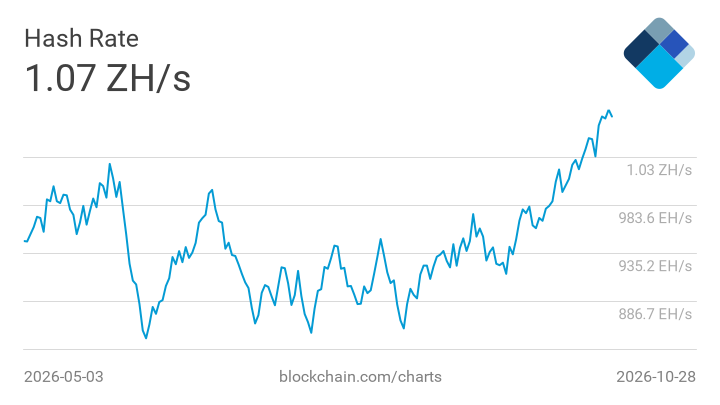
Welcome to the October issue of Bitcoin Forward, RootstockLabs’ institutional Bitcoin newsletter. This month, oil, Treasury yields and a hot inflation print pushed Bitcoin from above $86,000 to around $80,000. Beneath the price action, a European bank and a Korean bank moved Bitcoin custody and lending closer to the mainstream. The network itself kept getting stronger: Bitcoin’s hashrate climbed back to within about 7% of its all-time high, even as miners earned less per unit of computing power than a year ago.

The short version
- The sell-off was macro, not Bitcoin-specific. BTC traded with oil and long-dated yields, not on any change in its own fundamentals.
- Hashrate near its record shows miners are still investing in the network, too.
- The plumbing kept improving. Bank custody in Germany and bank lending in South Korea are both signs that BTC is being treated as financeable collateral.
- The Fed held, but December is live. Rates stayed at 3.75%–4.00% on October 28, with two officials voting to hike. Next up is the eCash snapshot on October 31: if you hold BTC through a provider, check its fork policy now.
In this issue
- Oil and bond yields knock Bitcoin off $86,000
- Banks keep building: Deutsche Bank and Jeonbuk Bank
- What a 6% drawdown does to a BTC-backed loan
- The eCash fork: a checklist for holders
- Washington keeps moving without Congress
- Market data and signals
- Chart of the month
- What to watch
What to watch
- Oil and bond yields knock Bitcoin off $86,000
October started with Bitcoin above $86,000. Within a week it was below $82,000 for the first time since September.
The trigger came from outside crypto. Reports of Iranian attacks on tankers pushed Brent crude above $100 a barrel, and the 30-year US Treasury yield climbed past 5.7%. Higher oil feeds directly into inflation expectations, and higher inflation expectations push long-term yields up. Risk assets sold off together, and Bitcoin went with them.
Then on October 14, September’s CPI came in hotter than forecast. That removed any quick path back to $86,000 and kept BTC pinned in the low $80,000s for the rest of the month.
- Why yields matter so much for Bitcoin
Bitcoin pays no coupon. When a 30-year Treasury pays more than 5.7%, the opportunity cost of holding a non-yielding asset goes up, and every allocator has to justify the position against a risk-free alternative that now looks generous. Rising yields also tighten financial conditions more broadly: borrowing costs rise, the dollar tends to firm, and leverage across markets gets more expensive.
None of that says anything about Bitcoin’s network, supply or adoption. It says that, in the short run, BTC still trades like a liquid risk asset that institutions can sell when they need to reduce exposure. Over longer periods the picture can be different, but October was a short-run month.
What it means for holders: macro-driven drawdowns are the scenario to plan for. They arrive fast, they are correlated with everything else in a portfolio, and they hit collateral values at the same moment other funding gets tighter.
- Banks keep building
Two of the month’s most important stories got less attention than the price chart. Both are about the infrastructure that lets institutions hold and borrow against Bitcoin inside the regulated banking system.
Deutsche Bank told Reuters its German custody service for Bitcoin, Ether and selected stablecoins is weeks away from launch, pending regulatory approval. The bank plans to expand the service to Asia in 2027.
Germany has had a dedicated licence for crypto custody since 2020, and Deutsche Bank has been working toward this for several years. What changes now is the timeline: this is no longer a pilot or a partnership announcement, it is a launch date.
For many institutions, the custodian is the gating question. Pension funds, insurers and some asset managers can only hold assets with a bank or a qualified custodian that meets their internal risk standards. A global systemically important bank offering Bitcoin custody widens the set of investors who can hold BTC directly, and gives existing holders another option for spreading counterparty risk across providers.
Jeonbuk Bank became South Korea’s first commercial bank to offer won-denominated loans secured by BTC. The collateral is held by a third-party custodian rather than by the bank itself, and amended enforcement rules allow court-ordered recovery of the collateral if a borrower defaults.
That last detail is the one that matters. A lender’s appetite for any collateral depends on two questions: can I value it, and can I take it if the borrower doesn’t pay? Bitcoin has always answered the first question well, with deep, 24/7 price discovery. Jeonbuk’s structure answers the second one in a court-recognised way. Segregated third-party custody keeps the collateral out of the lender’s own balance sheet, and a clear legal path to recovery means the bank can price the loan like any other secured credit.
Why it matters: custody and enforceable collateral are the two building blocks of bank-scale Bitcoin credit. Both advanced in October, during a down month. When this kind of infrastructure keeps getting built through a sell-off, it suggests the institutions behind it are planning on a multi-year view rather than reacting to price.
- What a 6% drawdown does to a BTC-backed loan
For holders who borrow against Bitcoin, the useful question about October is not “where did the price go?” but “how close did my loan get to a margin call?” Here is a worked example.
Say a treasury company pledged 1,000 BTC on October 1, when Bitcoin was about $86,000, and borrowed $43M in stablecoins. That is a 50% loan-to-value (LTV). Assume the loan has a margin call at 70% LTV and liquidation at 80%.
| BTC price | Collateral value | LTV | Status |
| $86,000 (Oct 1) | $86.0M | 50.0% | Opening position |
| $81,000 (Oct 20) | $81.0M | 53.1% | Comfortable |
| $61,430 | $61.4M | 70.0% | Margin call |
| $53,750 | $53.8M | 80.0% | Liquidation |
October’s move took this loan from 50% to about 53% LTV. Uncomfortable, but nowhere near a call. Bitcoin would have needed to fall roughly 29% from its October high before the borrower had to post more collateral, and about 37% before liquidation.
The same drawdown looks very different at higher leverage. A loan opened at 65% LTV would have moved to about 69% by October 20, within a few points of the call. That is the difference between a month you watch and a month you have to act in.
The loan terms that matter in a sell-off. Learn more.
For a deeper look, see How Are Institutions Using Bitcoin as Collateral? 5 Emerging Use Cases.
- The eCash fork: a checklist for holders
Around Bitcoin block 973,728, expected on October 31, a separate chain will take a snapshot of Bitcoin’s ledger and credit ECX 1:1 to every BTC address. Bitcoin itself does not change. Your BTC stays where it is, and the Bitcoin network keeps running as normal.
Holders have been here before. When Bitcoin Cash split off in 2017, every BTC holder was credited with BCH on the new chain. Some custodians and exchanges credited clients quickly, some took months, and some never supported it at all. The same is likely to happen with ECX.
If you hold BTC with a custodian, exchange or ETF
- Ask whether they will support ECX. You receive it only if the provider chooses to.
- Ask who gets it. For an ETF or fund, forked assets may go to the fund rather than to individual investors. The fund’s documentation should cover this.
- Ask about timing. Support may come weeks after the snapshot, if at all.
If your BTC is pledged as loan collateral
- Check your loan agreement. It should say who is entitled to forked assets on pledged BTC. If it’s silent, ask your lender before the snapshot.
If you self-custody
- You control the keys, so you control any ECX. There is no rush to claim it.
- Never enter your seed phrase into a wallet or website offering to “claim” forked coins. Forks are a common moment for phishing.
- Be cautious about moving coins around the snapshot unless you understand how the new chain handles replay protection.
Forked assets can also have tax and accounting consequences, which vary by jurisdiction. Speak to your advisers.
- Washington keeps moving without Congress
With crypto legislation still stalled on Capitol Hill, the regulators are writing the rules themselves. In the first week of October:
- The SEC proposed crypto custody rules for investment advisers and funds. Custody rules decide where a registered adviser can hold client assets, so this directly shapes which providers institutional money can use.
- The CFTC opened its own crypto rulemaking, a reminder that oversight of digital assets is split between agencies.
- White House crypto adviser Patrick Witt stepped down, with no successor named.
Agency rules can move faster than legislation, but they can also be revised by a future commission. Until Congress passes a market structure law, institutions are building on a foundation that is clearer than it was, but not yet permanent. Both proposals will go through public comment, and the final text may look different.
On the podcast

Episode 3: Bitcoin Forward Podcast. Bitcoin is moving beyond simply being held on balance sheets. Richard Green and Tony DiCarlo discuss how Bitcoin-backed credit is becoming an institutional asset class, why securitisation matters, what allocators are actually asking for, and where hashrate, merged mining and insurance fit in.
If October’s drawdown has you thinking about loan terms, start with what happens during market stress and margin calls (07:14).
Market data and signals
Macro data and a pending Fed decision kept allocators cautious in October. Here are the numbers we’re watching, and what they suggest.
- Hashrate is near its all-time high. The 7-day average reached about 1,074 EH/s on October 28, roughly 7% below the 1,153 EH/s record set in October 2025. Hashprice, what miners earn per unit of computing power, is about 23% lower than a year ago. More here.
- ETF outflows topped $600M. US spot Bitcoin ETFs lost more than $600M in the week to October 9 as Treasury yields hit 24-year highs. This looks like allocators cutting risk across portfolios, not leaving Bitcoin specifically.
- Issuers kept building. BlackRock filed for a third Bitcoin ETF, one that gives up some upside in exchange for downside protection. It’s aimed at advisers whose mandates limit drawdowns.
- 6.4M BTC is underwater. That much supply was held at a loss when BTC fell below $81,000 on October 8. Holders waiting to break even could cap rallies in the $81K–$86K range.
- $550M of leverage was flushed out. Liquidations hit that level in 24 hours as BTC broke $84,000 on October 7 (CoinGlass). It made the drop sharper, but it leaves fewer forced sellers for the next move.
- CPI beat forecast: 3.7% vs. 3.6%. A small miss, but enough to keep further rate hikes on the table: the Fed held on October 28, but two officials voted to hike. Right now the path of rates matters more for BTC than any crypto headline.
Chart of the month
Bitcoin’s hashrate just climbed back above 1 ZH/s anyway, its highest since March. What does this imply? We’ve got you covered.
What to watch
- October 28: Fed rate decision. A hold with a softer tone would ease pressure on yields and give risk assets room. A hike, or strong signals of one, would test whether $81,000 holds.
- October 31: eCash snapshot. Confirm your custodian’s, lender’s or fund’s policy on ECX before the block.
- Weeks ahead: Deutsche Bank custody launch. Watch for regulatory approval and the first named clients.
- Ongoing: SEC and CFTC comment periods. The details of the custody proposal will shape which providers advisers can use.
From our vault
- RootstockLabs Q3 2026: Putting Bitcoin to Work
How the institutional team moved from access infrastructure into product design and capital deployment across Bitcoin-backed lending, tokenized funds and more. - How Are Institutions Using Bitcoin as Collateral? 5 Emerging Use Cases
From MARA’s $600M in Bitcoin-backed facilities to Ledn’s rated securitization, and which loan terms matter most when Bitcoin falls sharply.
Get the Bitcoin Forward newsletter in your inbox. One institutional briefing a month. No noise. Subscribe here.