A teenager’s breaking voice sounds worse before it sounds better. The old pitch is gone, the new one has not settled, and for a while all you get is the crack in between. That is where Bitcoin is right now. Some of the story that carried it for fifteen years has gone quiet, the story that replaces it hasn’t arrived, and the noise in the middle is being mistaken for decline. However, appearances can be deceptive. This isn’t decline, it’s the messy stage right before growth, the part where it’s still working out who it is. The clearest way to understand where Bitcoin is going is to compare Bitcoin vs gold.
Gold’s enduring strength comes from two distinct sources of demand: its long-term monetary value and its everyday utility. Bitcoin has established the first, but the second is only beginning to emerge. Understanding that transition starts with the voice Bitcoin is beginning to lose.
New report
Tony Dicarlo, author of this piece, explores these ideas in more depth in his new report, Bitcoin’s Awkward Age: Bitcoin’s Next Source of Structural Demand.
Part one: the child
The birth of sound money
Bitcoin’s first, younger voice was clear and simple, and for a long time it was right.
It started with an idea. Bitcoin was born out of the 2008 financial crisis and its first block carried a headline about UK bank bailouts written into code.
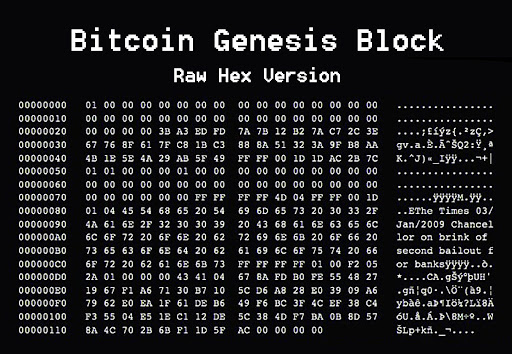
The message was not subtle. Here was money no government could print and no central bank could debase. Sound money, enforced by mathematics and code rather than political discretion. In a decade defined by quantitative easing and ballooning deficits, that idea found a large and committed audience.
The supply metrics backed it up. Bitcoin is the hardest money ever created. Twenty one million coins, fixed forever, with issuance already below 1% a year and falling to zero through halvings every four years. Gold, the benchmark for hard money across human history, still grows its supply 1.5 to 2% a year through mining. By any conventional measure of monetary scarcity, Bitcoin is harder than gold, and unlike gold its scarcity is not a geological estimate but a mathematical certainty enforced by twenty thousand independent nodes.
When scarcity met speculation
The idea attracted believers. They bought. Rising prices attracted more believers, who bought in turn. That loop produced extraordinary returns. Bitcoin’s long-term returns have been extraordinary. Even as its growth has moderated, Bitcoin compounded at 25% annually over the five years to January 2026. In the early years, speculation powered much of that rise, but it kept being reinforced by the underlying scarcity story. That belief kept being validated. Year after year the price confirmed the story and speculation hardened into conviction. For more than a decade, Bitcoin didn’t need another source of demand. Scarcity and speculative belief were enough.
By early 2024 the child’s voice was at its peak. Spot ETFs launched in the US and pulled in more than $50 billion faster than any ETF in history. Institutions arrived. Corporate treasuries began accumulating. The monetary thesis, the scarcity and the returns all pointed in the same direction. Everything was working.
Which is usually the moment a voice starts to break.
Part two: the awkward age
When the voice finally cracked, it revealed bitcoin’s first identity crisis.
By mid-2026 bitcoin had become one of the weakest major asset classes on the board, down around a third year to date and briefly touching 50% below its October 2025 peak. Almost everything else advanced. The S&P 500 is up roughly 9%, small caps around 19%, value stocks about 15%. REITs gained about 9%, commodities rallied hard, and even bonds held roughly flat. In a year when nearly every corner of the market worked, bitcoin, the asset built to outperform a debasing financial system, was one of the only things that fell.
The most uncomfortable comparison is Bitcoin vs gold. Gold ran more than 60% in 2025, setting 53 record highs, while bitcoin faded. The asset marketed as digital gold, the harder and faster version of the same monetary bet, lost badly to the original. When the safe haven bid arrived, it went to the metal, not the code.
To understand why, you have to separate the two things Bitcoin has been standing on. Neither has failed, but each has a different problem. One is being judged against the wrong test. The other has simply lost the market’s attention.
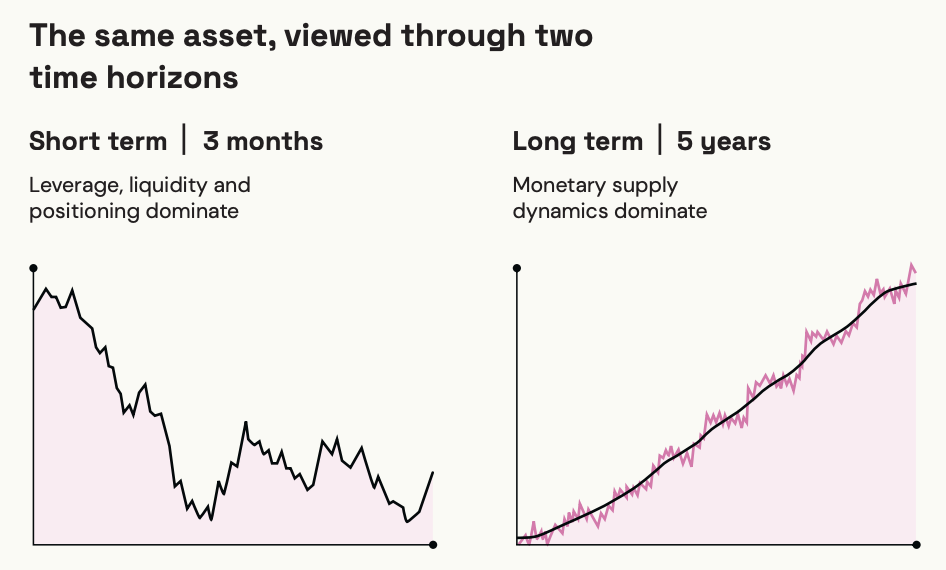
The first is the hedge. Bitcoin’s real monetary case is not that it protects you in the first hours of a crisis. It’s that it protects you against the slow debasement of money over years. That case is intact. Bitcoin has appreciated over 90% against the Argentine peso and more than 200% against the Turkish lira during those currencies’ crises. The hedge works, just on a long clock as a quiet undercurrent rather than a daily headline. When the US-Iran war erupted in February 2026, bitcoin was the only major asset open, dropped more than 8% on the weekend, and got used as a global panic vent. Plenty of people threw in the towel on the safe haven story then and there. They were holding it to the wrong test though. It was never designed to be a war haven. It is a debasement hedge, and that pull is too slow and too far out to set the price on any given day.
Where did the speculation go?
The second is speculation, and this is what actually held the price up day to day. The volatility and outsized returns were never a side effect of bitcoin, they were one of its core attractions, the thing that served believers and traders alike. For years bitcoin was the high alpha, high volatility, herded trade. It no longer is. Gold reclaimed the safe haven narrative on de-dollarisation and Middle East tension. AI and semiconductors took the growth story. And prediction markets and zero day options gave traders a faster dopamine loop, bet on an election, a Fed decision, a sports result, even the weather and settle it the same day. The speculative crowd that once needed bitcoin now has shinier places to go, and the attention drained away with it.
Put those together and you get what everyone sees on the screen. With the hedge too slow to drive today’s price and speculation losing its pull, short term price action is increasingly driven by leverage rather than fundamentals. Derivatives now account for more than 73% of Bitcoin trading volume, over three times the size of spot markets. Synthetic exposure through futures and options exceeds $95 billion, and in 2025 forced liquidations across crypto reached roughly $150 billion. When leverage unwinds, selling floods into spot markets and Bitcoin’s 21 million supply cap becomes almost irrelevant over that time horizon. This isn’t unique to Bitcoin. Gold fell around 20% in a week during 2011 despite no change in its physical supply. Oil futures briefly traded below zero in 2020. Markets don’t continuously reflect fundamentals. They oscillate around them, sometimes violently. Fixed supply wins eventually, but it does not carry a voice in the short term.
The identity gap
So the awkward age is a gap of identity. The hedge is real but too slow to be felt. Speculation is fading because it is no longer unique. And while Bitcoin’s financial utility is beginning to emerge, it has yet to become a large, durable source of demand independent of the expectation that someone else will pay more tomorrow.
But this stage is anything but idle, and this is the part the price on screen hides. Bitcoin has never been busier. For the first time, much of that activity is focused on making Bitcoin useful rather than simply making it valuable. Beneath the cracked voice, an entire industry is working to build an identity beyond simply being a hedge, one that puts to work the combination of qualities Bitcoin uniquely holds, a permanently fixed supply, global settlement without intermediaries, native digital ownership, transparent verification, high divisibility, programmable money, and growing institutional acceptance. No previous asset has combined all of these in one place, and it is that combination that makes Bitcoin suited to finance rather than industry. Digital Asset Treasuries are creating digital credit with Bitcoin as a backbone. Developers are building non-custodial infrastructure that lets Bitcoin be used on-chain without surrendering it to a third party. Miners continue pushing efficiency, turning stranded energy and waste heat into hashrate. None of this shows up in the price, but all of it is a teenager growing up. The values it was raised on, the hedge against debasement, are still firmly in place, humming away underneath just as they always did. What is changing is the brash, speculative young self that defined its early years. Nothing has quite replaced it yet. So it does what any of us do at that age. It tries new things, tests itself, and searches for who it really is.
Part three: growing up
Bitcoin vs gold: What Bitcoin can learn from gold
This is where the gold comparison pays off, because gold never stood on the safe haven story alone. And this is where growing up stops being painful and starts revealing what Bitcoin can become, because what waits on the other side is a more durable identity than the child or teenager ever had.
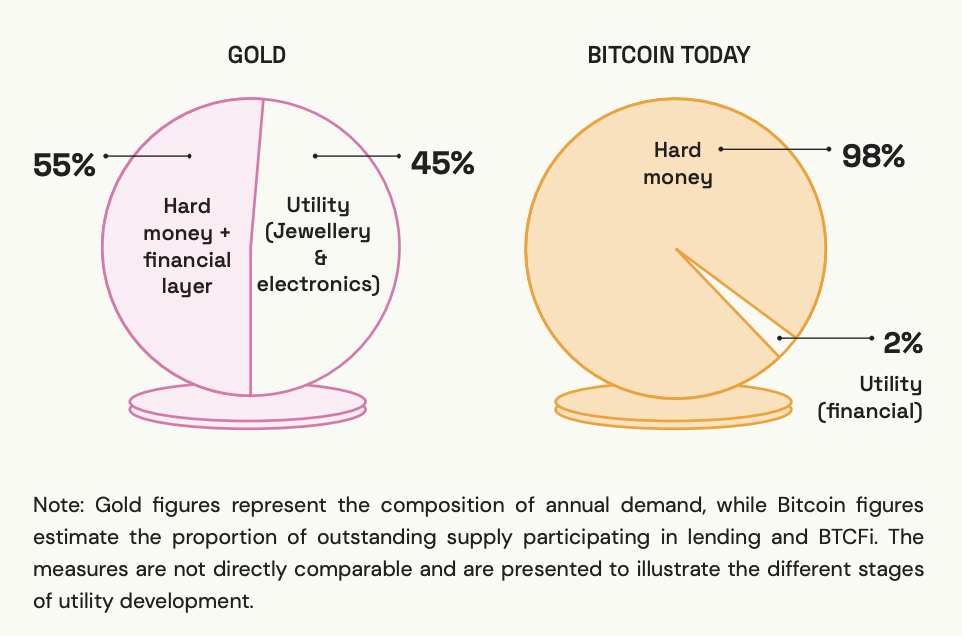
Gold has two sources of demand. One is monetary, the millennia-old store of value everyone talks about, a slow, long-term anchor. The other is functional and immediate. Jewellery and electronics accounts for roughly 43% of gold’s annual demand, creating a recurring source of demand beyond its monetary role. The two operate on different clocks, one playing out over decades, the other renewing itself every year. Together, they give gold something Bitcoin has yet to fully develop: two durable sources of demand reinforcing the same asset.
That is exactly what Bitcoin has been missing, a durable source of near term demand to sit alongside its long term monetary hedge. Speculation filled that role for a while, but speculation is fleeting. It survives only while momentum lasts and disappears the moment attention moves elsewhere. What Bitcoin needs is the equivalent of gold’s jewellery, a genuine use that creates year after year demand, regardless of the story of the day. Utility is what completes Bitcoin’s identity, and it is arriving through financialisation, on two tracks.
Making liabilities productive
The first rests on a simple belief. Over the long run, an asset with permanently fixed supply may appreciate against currencies whose supply continues to expand. Accept that, and a structural opportunity emerges. Hold Bitcoin on the asset side of the balance sheet while financing it through fiat-denominated liabilities. If Bitcoin appreciates faster than the cost of financing, the spread creates value while inflation may gradually erode the real burden of those liabilities.
Spread trades are nothing new. The Japanese yen carry trade demonstrated how borrowing in one currency to invest in higher-returning assets can create enormous opportunities from relatively small spreads. Bitcoin introduces a potentially different scale. It appreciated at an annualised 25% over the five years to January 2026, far exceeding typical financing costs which has depreciated in fiat terms at 8-10% per year. If that relationship persists, the implications for balance sheets could be significant. But unlike a conventional low-volatility carry trade, Bitcoin’s price can fall sharply, and financing obligations remain payable regardless of its performance.
Strategy is demonstrating how this model can operate at scale. By raising capital through equity, debt and preferred securities to acquire Bitcoin, it has built a balance sheet designed to benefit from Bitcoin appreciating faster than its financing costs, while servicing dollar-denominated obligations, including preferred dividends.
Battery Finance is exploring how the same principle could extend into property finance, incorporating Bitcoin exposure into mortgage structures that potentially share long-term appreciation between lender and borrower.
Put yourself in the borrower’s shoes. If your lender offered to allocate a small portion of your 25-year mortgage financing to Bitcoin, without increasing your borrowing costs, and gave you the opportunity to pay down your mortgage faster if Bitcoin appreciated, would you take it?
That is where this leads.
The reason it can grow into Bitcoin’s version of jewellery is the sheer scale of liabilities it can attach to. Global residential and commercial mortgages represent an estimated $300 trillion, sovereign debt another $100 trillion, corporate debt around $90 trillion and insurance assets and reserves approximately $40 trillion. Including infrastructure and structured finance, these markets total roughly $560 trillion. Each represents a vast pool of dollar-denominated financing that could potentially incorporate Bitcoin to capture the same spread. If even a fraction adopts this model, productive liabilities could become one of the largest sources of structural Bitcoin demand in existence. And crucially, it requires no one to buy, hold or understand Bitcoin directly. It works silently inside the everyday financial products people already use.
Making Bitcoin assets productive
The second form of financial utility is making Bitcoin assets productive. Rather than simply holding Bitcoin and waiting for appreciation, institutions can put existing holdings to work through lending, structured credit, liquidity provision and yield-generating strategies.
The principle is simple. Once an asset becomes widely owned, financial markets find ways to make it productive. Companies, funds, ETFs and governments now hold more than 3.9 million BTC, around 18.6% of total supply. That creates a growing incentive to generate returns from existing holdings. Asset managers can offset custody and operating costs, treasury companies can grow their Bitcoin reserves, and miners can generate additional income without selling their holdings.
But Bitcoin has no inherent yield. Returns must come from genuine economic activity or financial strategies, each carrying its own risks. For institutional investors, the opportunity is not simply earning more Bitcoin. It is developing transparent, well-underwritten strategies that generate credible returns while prioritising capital preservation.
The size gap shows how early we are. Around 1.5% of Bitcoin’s supply participates in lending and BTCFi, compared with over 15% of Ethereum’s supply deployed in DeFi and 5 to 7% securities lending participation in equities. These are different markets, but the contrast illustrates how little of Bitcoin’s financial potential has been developed.
The full report looks at why that gap exists and what it would take to close it.
The gap isn’t simply about infrastructure. It’s about who owns the asset. A Bitcoin investor measures success differently from a dollar investor. Their priority isn’t maximising dollar yield. It’s preserving and growing their Bitcoin holdings. Why take counterparty, custody or smart contract risk for a few percentage points of additional return when simply holding Bitcoin has historically delivered substantial appreciation?
That is the challenge institutional Bitcoin products must overcome. Returns need to be sufficiently attractive, transparent and well-underwritten to justify the risks of putting Bitcoin to work.
As Bitcoin matures and returns normalise, the incentive to make existing holdings productive grows. The opportunity is no longer to chase the highest headline yield, but to build transparent, auditable strategies centred on capital preservation that institutions can genuinely underwrite.
This evolution is taking shape through three overlapping stages.
The first is top down, with traditional financial institutions adapting familiar income products to Bitcoin. Options overlays, income-generating ETFs and institutional lending programmes are already creating ways to earn returns, typically in dollars, from Bitcoin exposure.
The second is bottom up, as specialist managers build financial products around Bitcoin itself. On and off-chain lending, derivatives, collateralisation and structured credit are opening new markets. In February 2026, a US$188 million securitisation of Bitcoin-backed loans received an investment-grade rating on its senior notes and was twice oversubscribed. Bitcoin-backed credit is already entering institutional capital markets.
The third, and potentially most significant, is Bitcoin-native yield. Regulated investment managers could combine strategies built around productive Bitcoin activity, including hashrate-backed credit, mining-related cash flows, on-chain finance and routing liquidity fees, into diversified, institutional-grade investment products. The ambition is to generate returns from Bitcoin’s own economy, allowing investors to earn in bitcoin.
Together, these stages mark a shift from adapting traditional finance to Bitcoin towards building an entirely new financial economy around it. Infrastructure such as Rootstock is helping enable that transition. The objective is not simply to earn more, but to make Bitcoin productive without abandoning the monetary principles that made it valuable in the first place.
How big can financialisation get?
This is where the Bitcoin vs gold gap is widest. Gold’s functional side is a major pillar of its demand. Jewellery and electronics account for roughly 43% of annual demand, alongside investment and central bank buying. Bitcoin’s financial utility, by comparison, is barely getting started. Around 1.5% of supply participates in Bitcoin lending and BTCfi, while public companies already hold more than 1.26 million BTC, roughly 6% of total supply. The ownership base is established, but the financial infrastructure to make those holdings productive is still emerging. That gap is the opportunity, and it is developing across both tracks.
Start with making Bitcoin assets productive. The opportunity is not simply to generate yield, but to change the economics of ownership. Rather than relying entirely on price appreciation, investors can earn recurring returns from their holdings. On illustrative assumptions, if 5% of identifiable institutional Bitcoin holdings generated a 5% annual return, 9,750 BTC could be distributed to investors each year. If institutional ownership doubled, that figure could rise to 19,500 BTC. These returns are not newly created Bitcoin, but income generated and redistributed through productive economic activity. The significance is a new financial incentive to acquire, retain and deploy Bitcoin.
Making liabilities productive opens an even larger opportunity. Mortgages, sovereign and corporate debt, insurance, infrastructure and structured finance represent an estimated $560 trillion in global financing. If Bitcoin were integrated into just 0.1% of these markets, that would represent $560 billion of Bitcoin-linked financing. At 0.5%, the figure rises to $2.8 trillion, and at 1%, to $5.6 trillion. These figures represent financing exposure, not direct Bitcoin purchases. Actual demand would depend on how much Bitcoin each structure required. And these scenarios exclude other potential applications, from employee remuneration and trade finance to entirely new Bitcoin-native financial markets.
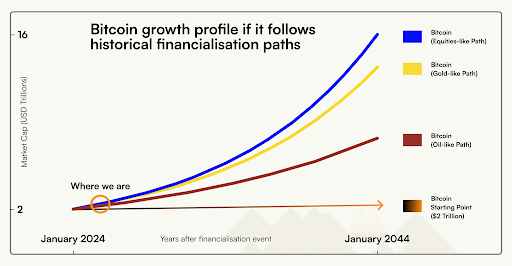
Put together, the two tracks describe an asset acquiring utility. One improves the productivity of Bitcoin already owned. The other threads Bitcoin into some of the largest financing markets on earth. At that point Bitcoin starts to look like gold, a long term hedge on one side and a substantial, functional source of demand on the other. The dual identity it has been missing begins to take shape.
These are illustrative scenarios, not forecasts. But they reveal the scale of the opportunity. Over time, Bitcoin’s financialisation could begin to resemble gold’s dual identity, where functional demand stands alongside its monetary role. Reaching that point would require Bitcoin to become embedded in a meaningful share of global financing markets, while institutional yield develops into a credible reason to acquire and retain the asset. Not every dollar of Bitcoin-linked financing translates into a dollar of Bitcoin purchases, but even modest adoption could create substantial, recurring demand. And these scenarios capture only the financial structures we can identify today, not the new markets that Bitcoin’s financialisation may eventually create.
And the shape of that demand matters as much as the size. A treasury allocating capital to Bitcoin creates demand as part of its financing strategy. A mortgage provider incorporating Bitcoin into new loans could generate buying at origination. An insurer systematically allocating a portion of its reserves could create recurring demand over time.
These are different from speculative purchases. They are driven by financing decisions, investment mandates and the everyday functioning of financial markets. Their scale would depend on adoption, allocation sizes and the amount of Bitcoin each structure actually requires. But the principle is powerful. Bitcoin could become embedded in financial products used by people who never knowingly buy a single coin.
This is the structural buyer Bitcoin has historically lacked, the equivalent of the pension mandate supporting equities or sovereign accumulation underpinning gold. Not demand that is immune to market conditions, but demand with reasons to exist beyond speculation.
This is not a price prediction. It is a claim about structure. Structures can endure long after narratives change. And as Bitcoin becomes more useful, its financial demand could begin to stand alongside its monetary role, just as gold’s functional demand complements its status as a store of value.
The grown-up voice
Bitcoin grew up on two promises. That it was a hedge against reckless central banks, and that it was the great speculative trading asset that could outrun everything. Growing up meant discovering which promise could endure.
The first holds. The fixed supply hedge is still real and intact, a strong undercurrent that works on a long clock the market keeps forgetting to read in the here and now. The second, speculation, proved fleeting. It never fully leaves, but it is unreliable, and it was never the identity that put Bitcoin’s best qualities to work. Bitcoin is no longer the only high octane trade in town, and this year it found that out the hard way, leaving it wondering who it actually is.
That discovery is the awkward age. Restless, self-conscious, trying on one identity after another to find the one that fits, and from the outside it looks like despair and decline. It is the opposite. It is Bitcoin doing what every mature asset, and every teenager, eventually has to do, working out who it really is. And the answer is not one thing or the other. It is both at once, the same way gold is. Gold never had to choose between being a store of value and being jewellery. It grew up by becoming both.
Bitcoin’s grown-up identity is beginning to take shape. The hedge against monetary debasement remains its foundation, but financialisation is giving it something new, a reason to be owned and used beyond the expectation of a higher price. Making Bitcoin assets productive gives existing holders a reason to put their capital to work. Making liabilities productive creates opportunities to embed Bitcoin into the everyday machinery of global finance.
That is what gold has understood for centuries. Its monetary value provides the long-term anchor, while its utility creates demand in the here and now. Bitcoin is beginning to develop the same dual identity, with one fundamental difference, its supply can never expand to meet that demand.
Perhaps Bitcoin’s most important years are still ahead. Not because it is becoming something different, but because it is becoming something more complete. The speculative teenager is finding its adult voice. And what once looked like an identity crisis may turn out to have been the beginning of Bitcoin finally growing into itself.
New report
In Bitcoin’s Awkward Age, Tony examines why price and fundamentals have diverged, what gold, bonds and property teach us about life after monetary success, and how financial utility could create new structural demand for a fixed-supply asset.
Disclaimer – Important Information
This article is provided for general informational and research purposes only and reflects the author’s views and opinions. It does not constitute investment, financial, legal or tax advice, nor an offer or solicitation to enter into any investment or financing transaction. Any products, structures, financing arrangements or financial strategies referenced herein are provided solely for illustrative, informational and educational purposes. RootstockLabs does not endorse, recommend or assume any responsibility or liability in connection with such products, structures, arrangements or strategies.
Any forward-looking statements, estimates or illustrative scenarios are based on assumptions that may not materialize and should not be relied upon as predictions or guarantees of future performance or returns. Bitcoin and related financial strategies involve risks, including price volatility, counterparty risk and potential loss of capital. Past performance is not indicative of future results.
RootstockLabs does not act as a financial adviser, investment manager or fiduciary to recipients. Certain structures may involve contractual counterparty exposure and may not constitute custody or safekeeping arrangements.