There’s an undeniable truth about anyone starting to explore bitcoin yield: BTC does not generate income on its own. There are no dividends, coupons or staking rewards for holding it. This is part of its design as a scarce monetary asset and digital store of value, rather than an inherently income-producing one.
But that doesn’t mean Bitcoin has to remain a passive asset as it evolves and becomes further embedded in capital markets and the wider financial services industry.
As Tony DiCarlo argues in Bitcoin’s Awkward Age, the next big opportunity is “to improve the productivity of Bitcoin ownership rather than relying exclusively on long-term price appreciation.”
These returns can come from lending, financial market activity, structured products, liquidity provision and other sources of economic demand. Some strategies generate income in fiat currencies, while others pay returns directly in BTC. Some rely on established financial mechanisms; others run on programmable, onchain infrastructure.
The question matters more now than it did a year ago. Bitcoin is down around 30% in 2026, and US spot Bitcoin ETFs recorded a record $4.7 billion in net outflows in November. As accumulation slows, more institutions are asking what the Bitcoin they already hold can do.
Although these approaches are often grouped under the term “Bitcoin yield”, they can be very different financial arrangements, with different sources of return and different risks.
This guide explains how Bitcoin yield works, where returns come from, the main types of arrangement, how yield behaves when markets change, and the infrastructure behind it. It also looks at the growing role of Bitcoin yield in institutional finance.
Key takeaways
- Bitcoin does not generate yield at the protocol level. Returns come from financial and economic activity around the asset.
- The main sources of Bitcoin yield are lending, real-world asset cash flows, structured financial strategies, liquidity provision and protocol incentives.
- Bitcoin yield can be paid in BTC, fiat currencies, stablecoins or other digital assets.
- Two products offering the same annual percentage yield can carry very different risks.
- Institutional Bitcoin yield is increasingly linked to capital efficiency, treasury management and productive asset ownership.
- Bitcoin layers and sidechains let Bitcoin be used in programmable financial applications, but they can add their own technical risks, require careful assessment and often benefit from pulling in third party expertise from firms with a track record in pricing and managing risk like RootstockLabs
- Bitcoin yield is not risk-free, and earning more BTC does not protect against a fall in its market value.
₿ What is Bitcoin yield?
Bitcoin yield is income or returns earned by putting Bitcoin, or financial exposure linked to Bitcoin, into economic activity beyond simply holding it.
In conventional finance, yield is a familiar idea. Bonds pay interest, property earns rent, and some equities pay dividends. In each case, the return can be traced to an underlying financial or economic activity.
Bitcoin is different because the asset itself produces no cash flows. Its investment case has historically rested on scarcity, decentralised ownership, monetary properties and the potential for long-term price appreciation.
Bitcoin yield adds another dimension: the possibility of earning returns by putting existing holdings to financial use. That could mean lending Bitcoin to borrowers, providing liquidity to markets, taking part in structured investment strategies or using Bitcoin in programmable financial applications.
The term is broad, though, and doesn’t describe a single product. A Bitcoin lending arrangement, a derivatives-based income strategy and an onchain liquidity position can all be called Bitcoin yield, yet they earn returns in very different ways. Understanding those differences is central to understanding Bitcoin yield.
₿ Why doesn’t Bitcoin generate yield natively?
Bitcoin uses proof of work to validate transactions and secure its network. Miners commit computing power to the network and are paid in newly issued bitcoin and transaction fees.
Those rewards pay miners for their work. They are not paid to individuals or institutions simply for owning Bitcoin. This differs from proof-of-stake networks, where holders can stake assets to help validate the network and earn protocol-level rewards. Bitcoin has no equivalent native staking mechanism.
An investor holding 100 BTC in a self-custodied wallet will still hold 100 BTC later, assuming no transactions or loss of access, however much economic activity happens across the network.
Any additional return must therefore come from economic activity outside the act of holding Bitcoin. This matters when evaluating products described as Bitcoin staking, Bitcoin savings or native Bitcoin yield. They may use legitimate financial mechanisms, but their returns are not staking rewards issued by the Bitcoin protocol.
₿ Where does Bitcoin yield come from?
Most Bitcoin yield can be traced to five broad economic sources.
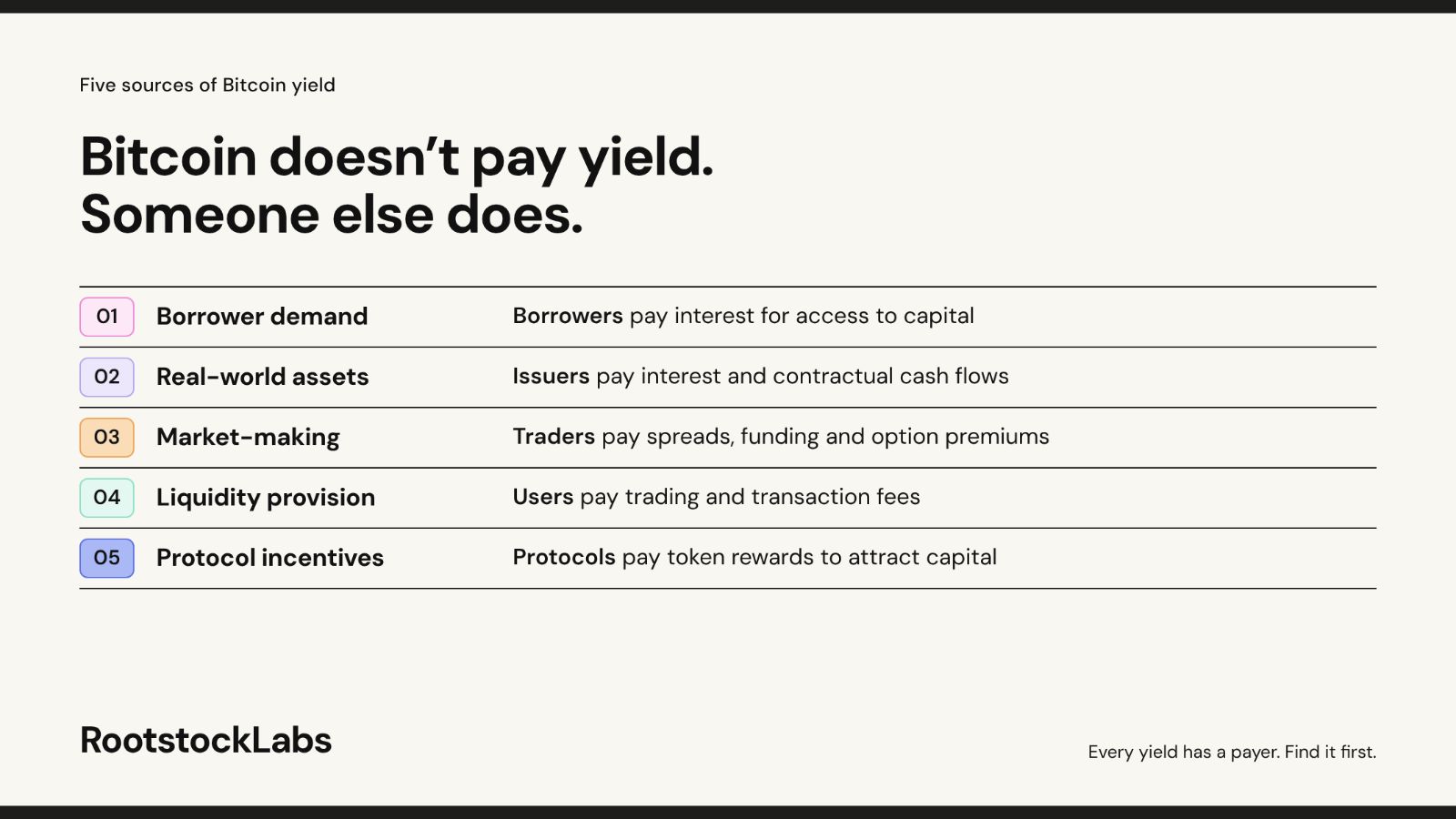
| Source of yield | Who pays the return? | Underlying economic activity |
|---|---|---|
| Borrower demand | Borrowers | Interest paid for access to capital |
| Real-world assets | Issuers and obligors | Interest and contractual cash flows |
| Market-making and structured strategies | Financial market participants | Trading spreads, funding differentials and risk transfer |
| Liquidity provision | Users of financial applications | Trading and transaction fees |
| Protocol incentives | Protocol treasuries | Token emissions and participation subsidies |
These sources often overlap, and one product may combine several. A lending application might pay borrower interest alongside protocol incentives. A structured product might combine derivatives income with returns from short-dated government securities. Breaking a return into its parts gives a clearer picture of its economics.
For a shorter introduction to these five sources, see Where Does Bitcoin Yield Actually Come From?
1. Borrower demand
Lending is one of the most established ways to earn a financial return. A borrower needs capital and agrees to pay interest. A lender provides that capital and is paid for taking on credit, liquidity and operational risk.
In Bitcoin finance, borrowers can include trading firms, institutional investors, mining companies and businesses seeking liquidity. Bitcoin can take part in two distinct ways:
- Lending Bitcoin: BTC is lent to a borrower, who pays interest to the lender.
- Borrowing against Bitcoin: BTC is posted as collateral for a loan in another asset, such as US dollars or stablecoins.
These serve different purposes. Lending Bitcoin can earn income for the lender. Borrowing against Bitcoin gives the borrower liquidity, but costs interest rather than earning it.
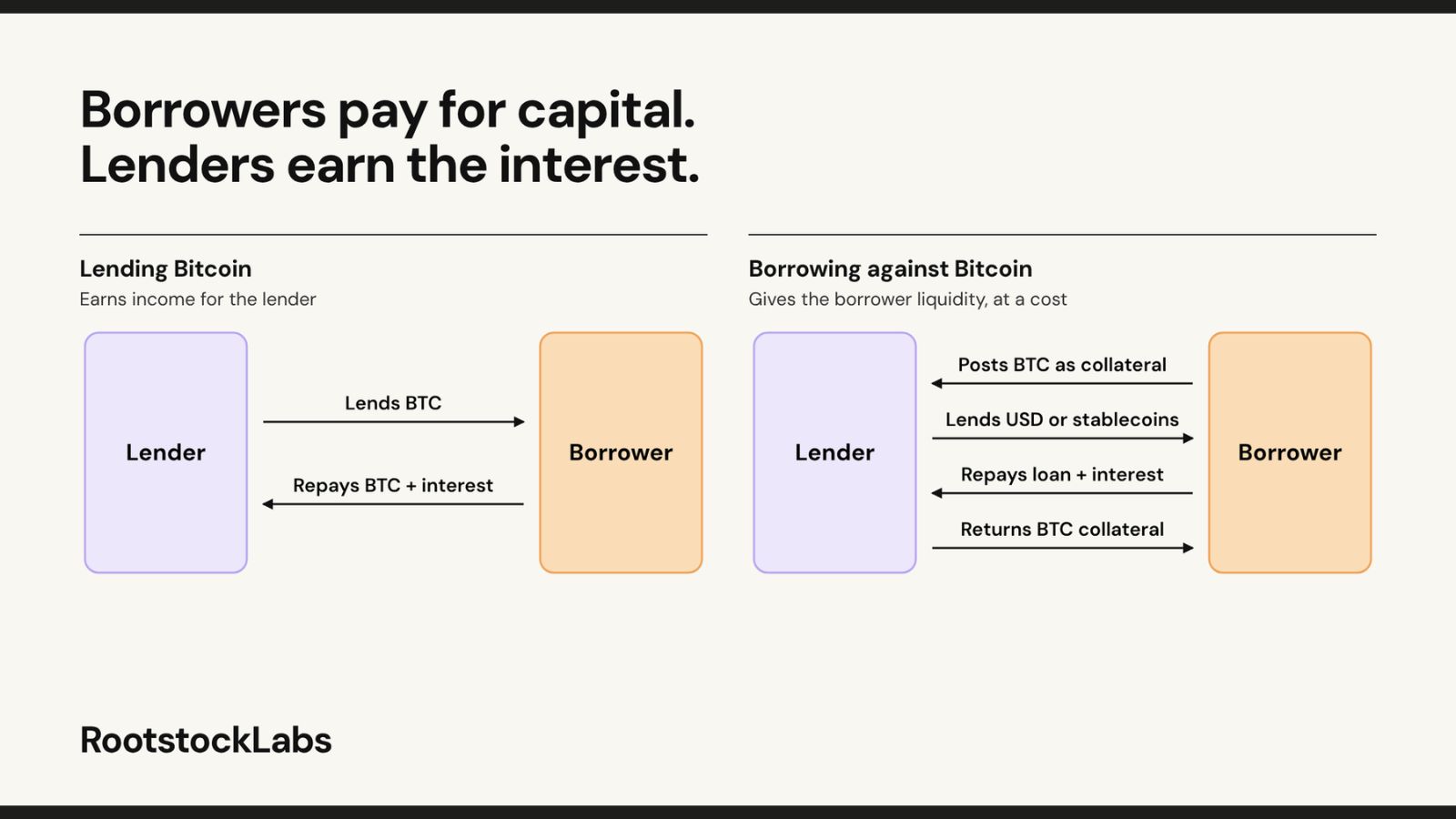
Bitcoin-backed lending usually involves collateral requirements, loan-to-value ratios, margin calls and liquidation mechanisms. Whether the loan runs through a traditional institution or an onchain application, the lender’s return still comes from borrower interest.
2. Real-world asset cash flows
Tokenised real-world assets give Bitcoin-related capital another route to financial returns. Government securities, private credit, corporate debt and trade finance all produce income from underlying contractual cash flows.
Tokenisation changes how these instruments are represented, transferred and settled. It doesn’t change where the return comes from. A tokenised Treasury instrument earns from the government securities it represents. Tokenised private credit depends on payments from the underlying borrowers.
Bitcoin can connect to these markets through collateral arrangements, structured products or programmable applications. For example, a structure might borrow stablecoins against Bitcoin and put them into an income-producing asset.
The gross return of the underlying investment is not the net return of the whole structure. Financing costs, fees, collateral requirements and market exposure all affect the outcome. The creditworthiness of the underlying asset matters whatever blockchain it’s issued on.
3. Market-making, basis and structured strategies
Financial markets need liquidity, execution, hedging and risk transfer. Market-making and derivatives strategies earn returns by providing them.
Market makers earn spreads by facilitating trades. Basis strategies aim to capture price differences between spot and futures markets. Options strategies earn premium in exchange for taking on specific contractual obligations. These techniques have long existed in traditional markets and are increasingly applied to Bitcoin.
Their returns differ from lending income because they depend on market conditions, volumes, volatility, positioning and execution. A cash-and-carry trade may capture a positive gap between Bitcoin’s spot and futures prices, but that gap can change quickly. Options premiums may rise when volatility rises, but so does the exposure behind them.
These returns come from market activity, not from the Bitcoin protocol.
4. Liquidity provision and transaction fees
Markets need liquidity to work. In onchain applications, liquidity providers supply assets that let other users trade, exchange or access financial services. In return, they may receive a share of the fees from that activity. The economic payer is the user of the service.
Decentralised exchanges, stablecoin markets and cross-asset trading applications are all places where liquidity provision can earn income.
Unlike fixed interest, fee income depends on how much activity there is. More trading can mean more fees; less activity, or more competing liquidity providers, can mean lower returns.
Liquidity provision can also change the mix and relative value of the assets supplied to a pool. That price effect needs to be separated from the fees the position earns.
5. Protocol incentives
Onchain applications often use token incentives to attract liquidity and users. These can add to returns from lending, trading or other activity.
For example, a product advertising 10% a year might earn 3% from borrower interest and 7% from protocol token distributions. Both count toward the headline rate, but they come from different places. The interest reflects demand for capital. The tokens are a subsidy to encourage participation.
Whether that subsidy continues may depend on the protocol’s emissions schedule, treasury and governance decisions. The tokens’ value can also move independently of the underlying activity. Protocol incentives are therefore different from recurring income backed by borrower demand or transaction fees.
₿ Three tests for any Bitcoin yield
Before comparing rates, three simple tests help show what a Bitcoin yield product actually is.
- The payer test: who is paying the return, and what are they paying for? If you can’t name the borrower, trader, user or issuer behind the return, you can’t judge whether it will last.
- The incentive-free test: what would the return be without token incentives? Strip out subsidies and look at what’s left from interest, fees or cash flows.
- The regime test: what market conditions produced the track record? A return built in a rising, high-volume market may behave very differently in a falling, thin one.
A product that passes all three can still lose money. One that fails any of them needs a clear explanation before capital goes in.
₿ What are the different types of Bitcoin yield?
The five sources above can be built into several types of financial arrangement.
| Type | How returns are generated | Typical return denomination |
|---|---|---|
| Direct Bitcoin lending | Interest paid by borrowers accessing BTC | BTC or fiat |
| Structured credit | Interest and cash flows from underlying credit instruments | BTC, fiat or stablecoins |
| Covered-call strategies | Premiums from selling call options | BTC or fiat |
| Cash-and-carry strategies | Differences between spot and futures prices | Usually fiat or stablecoins |
| Market-making | Trading spreads and execution activity | Varies |
| Onchain liquidity provision | Fees paid by users accessing liquidity | BTC-backed assets, stablecoins or other tokens |
| Tokenised financial asset strategies | Returns from underlying securities or credit instruments | Usually fiat or stablecoins |
| Bitcoin-native economic activity | Mining-related credit, service fees and other financial activity | Potentially BTC |
The denomination and exposure depend on the specific structure. A strategy that involves Bitcoin doesn’t necessarily pay returns in Bitcoin. Some approaches also need extra collateral, instruments or assets beyond the original Bitcoin position.
So “earning yield on Bitcoin” can describe anything from simple lending to complex, multi-asset investment structures.
₿ Bitcoin-denominated vs dollar-denominated yield
One of the most important distinctions in Bitcoin yield is the currency returns are earned and paid in.
Bitcoin-denominated yield
Bitcoin-denominated yield is paid directly in BTC or, depending on the arrangement, a redeemable BTC-backed asset. For an investor focused on long-term accumulation, it can increase the number of BTC held without new purchases.
Fiat-denominated yield
Fiat-denominated yield is paid in currencies such as US dollars or euros. It can fund operating expenses, debt servicing or other obligations. The investor can convert that income into Bitcoin, but that’s a separate transaction at the prevailing exchange rate.
Stablecoin-denominated yield
Some onchain applications pay returns in stablecoins. Stablecoins aim to hold a value linked to a fiat currency, but they bring their own considerations: the issuer, its reserves, redemption terms and the risk of drifting from their intended value.
Token-denominated yield
Other strategies pay returns in application or protocol tokens. The realised value depends on those tokens’ price and liquidity, which can behave very differently from Bitcoin.
The denomination matters because more income in US dollars is not the same as owning more Bitcoin.
How Bitcoin-denominated yield could compound over time
RootstockLabs’ institutional report, Bitcoin’s Awkward Age, illustrates how BTC-denominated returns could affect long-term holdings. Take a hypothetical investor holding 100 BTC, with returns paid and compounded annually in Bitcoin.
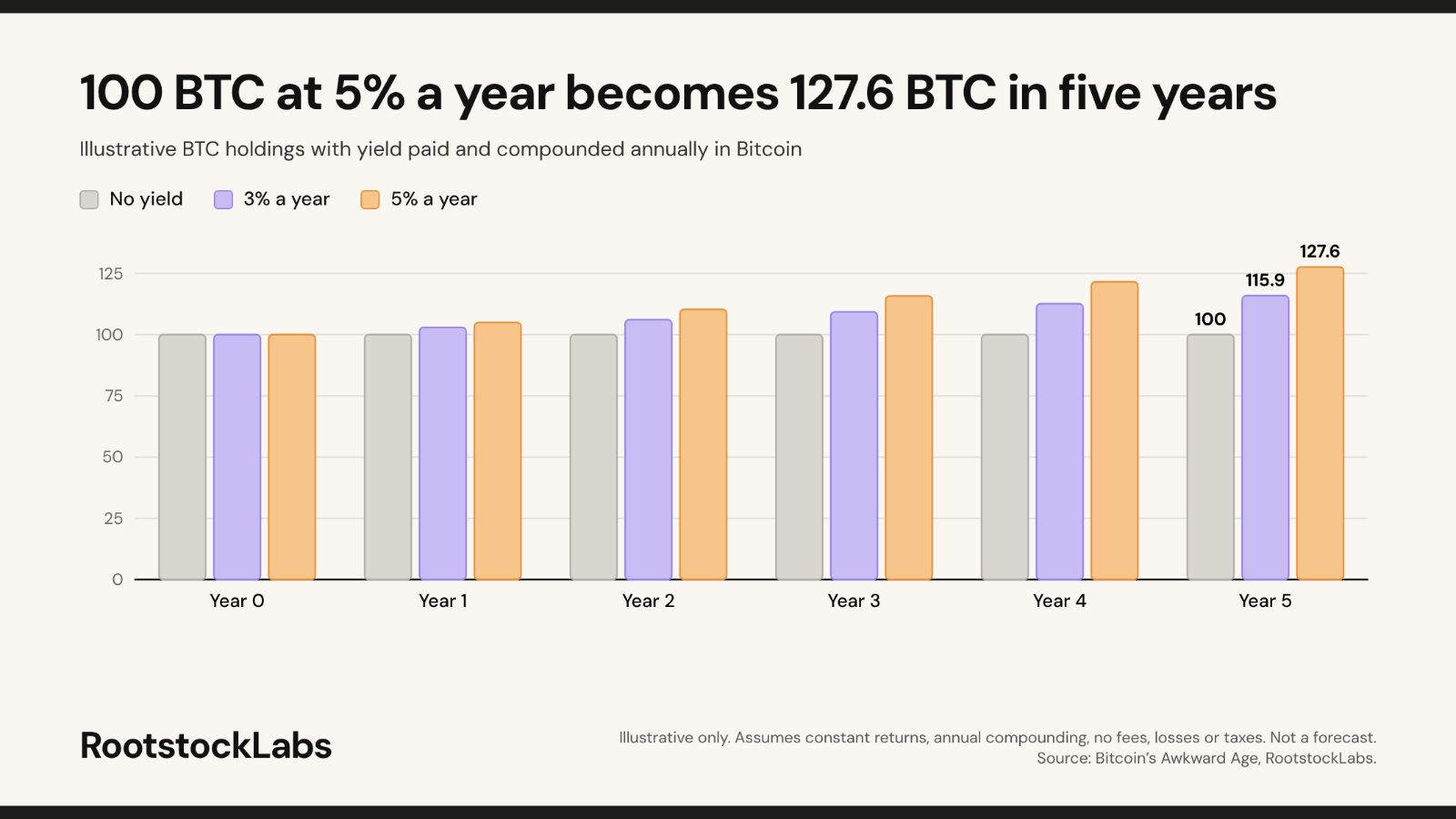
On these assumptions, 100 BTC would grow to about 127.6 BTC over five years at a constant 5% a year.
These calculations are illustrative. They assume steady returns, annual compounding, no additional purchases, no losses and no fees or taxes. They are not expected returns and don’t suggest such rates are reliably available.
₿ Centralised vs onchain Bitcoin yield
Bitcoin yield can be earned through centralised financial intermediaries and through onchain financial applications. The difference is in how activity is executed, administered and settled, not necessarily in where the return comes from.
A lending strategy run by a centralised institution and an onchain lending application might both earn borrower interest. Their operating structure, custody and risk assumptions can still differ a great deal.
| Feature | Centralised financial arrangements | Onchain financial applications |
|---|---|---|
| Execution | Managed by a financial intermediary | Executed through smart contracts or programmable systems |
| Custody | Often managed by the provider or a third-party custodian | May involve wallets, smart contracts or institutional custody integrations |
| Transparency | Depends on disclosures, reporting and contracts | Some positions and transactions can be publicly verified |
| Collateral management | Managed through contractual and operational processes | May be governed by programmable collateral rules |
| Liquidations | Executed through the provider’s processes | May be triggered automatically by smart contracts |
| Access | Subject to onboarding and eligibility requirements | Varies by application and access controls |
| Main additional risks | Counterparty, operational and legal risk | Smart-contract, oracle, governance and bridge risk |
Neither model removes financial risk. Centralised arrangements can draw on established contracts, professional underwriting and institutional service providers. Onchain systems can make some positions more visible and allow programmable settlement and collateral management.
Hybrid models are also emerging, combining traditional institutions, regulated custodians and onchain settlement. They reflect the growing integration of established financial markets with programmable blockchain environments.
₿ Understanding Bitcoin yield rates: APR, APY and actual returns
Bitcoin yield products usually quote annualised percentages. But different ways of calculating and presenting yield can make direct comparisons difficult.
- Annual percentage rate (APR): APR expresses a return on an annual basis without compounding. An illustrative 5% APR on 10 BTC means 0.5 BTC a year, assuming the rate holds and there are no fees or losses.
- Annual percentage yield (APY): APY includes compounding. If returns are reinvested during the year, the APY can be higher than the equivalent APR. The gap depends on how often returns compound and whether reinvestment is actually possible.
- Fixed vs variable yield: Some arrangements set a contractual rate for a fixed period. Others pay variable returns that move with borrower demand, utilisation, funding rates, trading activity or other conditions. An advertised variable APY is often an annualised snapshot of recent activity, not a commitment about future returns. A fixed rate doesn’t remove credit or counterparty risk either: someone in the structure carries the cost of paying it whatever the market does.
- Gross vs net yield: Gross yield is the return before deductions. Net yield is what’s left after management fees, financing costs, execution costs and other charges. For complex strategies, the gap can be large. Take a hypothetical arrangement earning 6% gross a year, with costs equal to 2% of the same capital. The net return is about 4%, before taxes and any investment losses.
- Realised vs advertised yield: An advertised yield is a projected, contractual or historical annualised rate. A realised return is what was actually received over a period. They can differ because of market conditions, liquidity limits, token-price moves, fees or losses.
A single headline percentage can’t fully describe the economics of a Bitcoin yield strategy.
₿ Can Bitcoin generate yield without being sold?
Bitcoin can be put into some financial strategies without selling it outright. Direct lending can earn interest in BTC. Bitcoin can also be represented in programmable environments as BTC-backed assets and used in onchain applications. Other strategies use Bitcoin as collateral to access liquidity or support positions.
Keeping Bitcoin exposure is not the same as keeping unencumbered Bitcoin in self-custody, though. Lending may mean handing control of the asset to another party. Collateral arrangements may lock up Bitcoin until obligations are met. Smart-contract positions can add redemption conditions and technical dependencies. A collateralised position can also be liquidated if its requirements are no longer met.
The differences between ownership, economic exposure, custody and the ability to redeem matter a great deal in Bitcoin yield arrangements.
₿ What happens to Bitcoin yield during a bear market?
This isn’t hypothetical. Bitcoin fell below $60,000 in November 2026 (down from a high an ATH of 126,000 in October 2025), and falling markets show clearly how different strategies respond to changing conditions.
A Bitcoin yield product can keep paying income while the capital behind it loses market value. Other strategies may see their profitability, collateral requirements or liquidity change as volatility rises. The effect depends on the source of the return.
| Yield source | Possible effects of falling Bitcoin prices |
|---|---|
| Lending | More collateral pressure, changing borrowing demand and possible defaults |
| Structured credit | Higher credit and collateral risk in Bitcoin-linked positions |
| Basis strategies | Changing futures premiums and funding rates |
| Options strategies | Higher or shifting premiums, with greater contractual and hedging exposure |
| Liquidity provision | Changing trading volumes, asset mix and market depth |
| Protocol incentives | Distributed tokens may fall in value |
| Real-world asset strategies | Underlying cash flows may hold up, while Bitcoin financing positions come under pressure |
Falling prices don’t affect all these mechanisms the same way. Trading can pick up when volatility rises, which may support fee income. Borrowing demand may shift as participants cut leverage or look for liquidity.
Three yield offers, one bad quarter
Take three hypothetical products, each advertising 5% a year on Bitcoin:
- The first earns its return from institutional lending.
- The second runs a market-neutral derivatives strategy.
- The third combines liquidity provision with protocol token incentives.
In calm markets, all three might show similar track records. Now imagine a quarter in which Bitcoin falls 30%, liquidity dries up and investors cut risk.
The lending product has to manage falling collateral values and possible defaults. The derivatives product has to manage shifting funding rates, margin calls, exchange exposure and execution costs. The liquidity product has to manage moving prices, changing volumes and a falling incentive token.
The same advertised 5% could produce three very different outcomes.
Yield does not remove Bitcoin price exposure
Take a hypothetical investor holding 10 BTC when Bitcoin trades at $100,000, a position worth $1 million. Over a year, the investor earns a 5% BTC-denominated return, taking the holding to 10.5 BTC. If Bitcoin’s price falls 30% over the same period, the position is worth $735,000.
| Start of period | End of period | |
|---|---|---|
| Bitcoin holdings | 10 BTC | 10.5 BTC |
| Bitcoin price | $100,000 | $70,000 |
| Portfolio value | $1,000,000 | $735,000 |
| BTC-denominated return | — | +5% |
| USD-denominated return | — | −26.5% |
This example excludes fees, taxes and other losses. It shows that a strategy can earn a positive return in Bitcoin while losing a large share of its fiat value.
Metaplanet shows the same thing at company scale. The Tokyo-listed Bitcoin treasury company earned around $55 million from Bitcoin options strategies in 2025. In the same fiscal year, it reported a net loss of about ¥95 billion, driven by the falling value of its Bitcoin holdings.
The income was real. It just wasn’t designed to offset the price move. Bitcoin yield and protection against Bitcoin price volatility are separate things.
₿ How sustainable is Bitcoin yield?
The sustainability of Bitcoin yield depends on the mechanism behind the return and the conditions it operates in. There is no universal sustainable Bitcoin yield rate.
A lending return, a market-making strategy and a liquidity position may each earn income, but they depend on different things:
- Borrower-driven yield depends on demand for capital, creditworthiness and effective collateral arrangements.
- Trading-based returns depend on market structure, volatility, execution and competition.
- Liquidity provision depends on users continuing to use financial services and pay fees.
- Protocol incentives depend on the supply and value of the assets being distributed.
How much capital chases the same strategy also matters. If more liquidity providers join a market while trading stays flat, the same fees are shared across more capital. More lending supply can push rates down if borrowing demand doesn’t grow with it.
Three characteristics explain most of the difference in how sustainable a Bitcoin yield is:
- The source of demand: whether the return comes from a real need for capital, liquidity, execution or another service.
- Dependence on subsidies: how much of the return comes from underlying activity rather than temporary incentives.
- Sensitivity to market conditions: how far the return depends on volatility, trading activity, funding rates or a particular market environment.
A higher return is not necessarily more sustainable, and a lower return doesn’t necessarily mean lower risk.
₿ Is Bitcoin yield safe? Understanding the risks
Bitcoin yield is not inherently safe or risk-free. Holding Bitcoin already involves price risk and custody considerations. Putting it into financial strategies can add further risks, and their type and size depend on the arrangement.
- Counterparty risk: Another party in the transaction fails to meet its obligations. That could be a borrower, lender, exchange, custodian, investment manager or other intermediary.
- Credit risk: A borrower or underlying obligor fails to make required payments. Collateral can reduce some credit exposure, but it doesn’t remove the possibility of loss.
- Collateral and liquidation risk: Bitcoin’s value can change sharply over short periods. When Bitcoin is collateral, a price fall raises the loan-to-value ratio and can trigger extra collateral calls or liquidation. For example, a $50,000 loan secured by $100,000 of Bitcoin starts at a 50% loan-to-value ratio. If the collateral falls to $70,000, the ratio rises to about 71.4%, assuming the loan balance is unchanged. Whether that triggers a margin call or liquidation depends on the agreement.
- Custody risk: This covers safekeeping, access controls, private-key management and the legal terms governing ownership. Bitcoin yield structures may use direct custody, third-party custody, smart-contract custody or a mix.
- Smart-contract risk: Onchain applications rely on software to execute transactions and enforce rules. Bugs, vulnerabilities or unexpected interactions between applications can cause losses. Audits, monitoring and formal verification reduce this risk but can’t guarantee there are no vulnerabilities.
- Bridge risk: Using Bitcoin on another blockchain may involve a bridge or two-way peg. That adds assumptions about how Bitcoin is locked, how matching assets are issued and how redemption works. Security models differ, so bridge design needs assessing separately from the financial strategy.
- Oracle risk: Onchain applications may rely on external price data to value collateral, trigger liquidations or execute contracts. Wrong, delayed or manipulated prices can affect those processes.
- Liquidity risk: This is the ability to exit a position, redeem an asset or meet obligations when needed. Some arrangements have contractual withdrawal periods; others depend on market liquidity. In stressed markets, exit costs and redemption delays can rise.
- Market and leverage risk: Structured products, derivatives and other strategies can add exposure to changing market conditions. Leverage magnifies gains and losses, and hedges can add execution, collateral and counterparty dependencies. A market-neutral strategy isn’t risk-free just because it aims to reduce directional Bitcoin exposure.
- Legal and regulatory risk: Financial arrangements can be affected by laws, regulation, jurisdiction and whether contracts can be enforced. Tokenisation or onchain execution doesn’t automatically settle questions about beneficial ownership, insolvency treatment or recovery rights.
Together, these risks show why the underlying arrangement matters as much as the advertised return.
₿ Bitcoin yield and institutional finance
Bitcoin yield matters to financial institutions because it raises questions familiar from traditional asset management: capital efficiency, income generation, liquidity planning and the trade-off between expected return and risk.
The motivations differ by type of institution.
| Institutional participant | Potential use of Bitcoin yield |
|---|---|
| Asset managers | Adding portfolio income and offsetting operating costs |
| Corporate treasuries | Earning recurring income from strategic reserves |
| Bitcoin miners | Diversifying revenue and covering operating expenses |
| Family offices | Building Bitcoin into wider portfolio and income strategies |
| Specialist investment funds | Developing differentiated credit and structured products |
The common thread is the chance to earn more economic value from Bitcoin already owned. But institutions work under different mandates, governance frameworks, custody requirements and liquidity limits. Whether a given arrangement suits them depends on those circumstances.
What do institutions look for in Bitcoin yield products?
In Bitcoin’s Awkward Age, RootstockLabs identifies the characteristics that matter most for institutional Bitcoin yield markets.
| Institutional consideration | Why it matters |
|---|---|
| Capital preservation | Financial strategies add exposures to the underlying investment |
| Transparent yield sources | Returns can be judged against the activity generating them |
| Risk management | Credit, counterparty, market and operational exposures can be identified and monitored |
| Auditability | Positions can fit into governance and reporting processes |
| Institutional custody | Safekeeping can meet operational and regulatory requirements |
| Predictable liquidity | Redemption and settlement terms can be built into liquidity planning |
| BTC-denominated returns | Returns can support long-term Bitcoin accumulation |
None of these is unique to Bitcoin. They are established institutional requirements applied to a new category of financial activity. Building Bitcoin yield products therefore means more than creating ways to earn returns. It also means building the operational, legal and technical infrastructure that lets institutions assess and access them.
What still holds institutional Bitcoin yield back
Six practical barriers keep many institutions on the sidelines:
- Custody vs yield: most yield strategies require moving BTC out of the custody setup an institution has already approved. Few let assets stay with a qualified custodian while they earn.
- Reuse of collateral: some providers rehypothecate (reuse) client collateral, so the same BTC can back several obligations. After past lender failures, that is a hard line for many risk committees.
- Incentive-driven returns: a large share of advertised onchain yield still comes from token incentives rather than interest or fees, which makes rates hard to rely on.
- Wrapped-asset risk: using BTC on other chains usually means holding a wrapped or bridged version, which adds issuer, bridge and redemption risk on top of the strategy itself.
- Reporting and accounting: positions spread across platforms and chains are hard to reconcile, value and audit in standard reporting processes.
- Fragmented liquidity: liquidity is split across venues, chains and wrapped assets, so large positions can be costly to enter or exit.
These barriers help explain why many institutions hold Bitcoin without putting it to work.
₿ How Bitcoin yield is entering established financial markets
Several developments show financial mechanisms from other asset classes being applied to Bitcoin.
Bitcoin options and corporate income
Metaplanet has built a Bitcoin Income Generation business centred on options strategies. In its FY2025 results, about 95% of revenue came from Bitcoin-related activity, mostly option premiums. It shows corporate Bitcoin strategies moving beyond accumulation into financial market activity. Options premium is payment for taking on specific market exposures, not income produced by Bitcoin itself.
Securitisation of Bitcoin-backed loans
In February 2026, Bitcoin lender Ledn closed a $188 million asset-backed securities deal backed by a portfolio of Bitcoin-collateralised loans. S&P rated the senior notes BBB-, the first investment-grade rating on a digital asset-backed security, and the deal was more than twice oversubscribed.
Securitisation packages portfolios of income-producing assets into securities with different risk and return profiles. Applying it to Bitcoin-backed loans connects Bitcoin credit markets with mainstream institutional capital. The return on these securities comes from the underlying loans, not from owning Bitcoin directly. An investment-grade rating doesn’t remove the risks.
Programmable Bitcoin financial markets
Alongside these traditional structures, onchain applications are building programmable lending, liquidity and settlement. BTC-backed assets can be used in applications where transactions, collateral rules and settlement run through smart contracts.
These developments are different routes for bringing Bitcoin into financial markets, from conventional institutional structures to blockchain-native applications.
₿ How large could the Bitcoin yield market become?
Financial applications around Bitcoin are growing, but productive Bitcoin ownership is still limited.
According to Bitcoin’s Awkward Age, identifiable institutions held an estimated 3.9 million BTC at the time of the research, including public companies, investment funds, governments and other institutions. The report also estimates that around 1.5% of Bitcoin’s supply participates in lending and Bitcoin-native financial markets. The gap between ownership and use is large.
The report models hypothetical scenarios based on the share of institutional holdings put into BTC-denominated yield strategies.
| Share of institutional holdings deployed | BTC deployed | Annual return at 3% | Annual return at 5% |
|---|---|---|---|
| 1% | 39,000 BTC | 1,170 BTC | 1,950 BTC |
| 5% | 195,000 BTC | 5,850 BTC | 9,750 BTC |
If identifiable institutional holdings doubled to 7.8 million BTC, and 5% of them earned a hypothetical 5% a year in BTC, the annual return would be 19,500 BTC.
These are illustrative calculations, not forecasts. They assume set participation levels and constant positive returns, with no losses, costs or changes in market conditions. They show how even limited participation by institutional holders could add up to meaningful financial activity.
₿ What infrastructure supports Bitcoin yield?
The economic source of a return is only one part of a financial arrangement. The other is the infrastructure the activity runs on.
Traditional Bitcoin products may rely on exchanges, intermediaries, custodians, clearing and contractual settlement. Onchain applications add programmable infrastructure for executing and settling transactions.
Bitcoin’s base layer provides monetary settlement and supports some programmable transaction conditions. More complex financial applications usually need infrastructure that supports general-purpose smart contracts, automated processes and interaction between digital assets.
That need has produced Bitcoin layers, sidechains, payment networks and other systems that extend Bitcoin’s functionality. They differ in consensus, execution, custody, asset representation and settlement, and their design affects the extra risks of using Bitcoin-related applications.
When assessing infrastructure, institutions typically look at how the network is secured, how BTC is moved onto it and redeemed, how long the system has operated through different market conditions, and which institutional custodians support it.
Network security, bridge design and custody address parts of infrastructure risk. They don’t remove the financial or application-specific risks of individual strategies.
₿ Bitcoin yield vs broader Bitcoin financial utility
Bitcoin yield is one part of a wider development in Bitcoin finance. Other applications can improve access to liquidity, support corporate financing or create new capital-market structures without earning yield on Bitcoin. These include:
- Bitcoin-backed borrowing
- Corporate treasury financing
- Liability management
- Collateral markets
- Structured credit and securitisation
- Programmable financial settlement
- Emerging Bitcoin-denominated capital-market instruments
A company borrowing against Bitcoin can get working capital without selling its holdings. That is financial utility, even though the company pays interest rather than earning it. Similarly, a treasury structure pairing Bitcoin assets with fiat liabilities is a balance-sheet strategy, not necessarily an income-producing investment.
Bitcoin’s Awkward Age explores this distinction. It identifies two emerging pillars of Bitcoin’s financial utility: making Bitcoin assets productive through income, and structuring liabilities around long-term Bitcoin ownership. Both widen Bitcoin’s financial uses, but their economics differ.
₿ Where Bitcoin yield stands today
The first generation of Bitcoin investment products focused on access. Exchanges, institutional custody and regulated investment vehicles made it possible for individuals and organisations to buy and hold Bitcoin.
Financial activity around those holdings now exists at several levels: Bitcoin lending, options income, securitised Bitcoin-backed loans, and onchain lending and liquidity markets. These operate at different scales and carry different risks. Around 1.5% of Bitcoin’s supply currently participates in lending and Bitcoin-native financial markets.
Taking part is optional. Passive ownership remains a distinct approach, and many holders choose not to put their Bitcoin to work. For those that do, the source of the return, the structure behind it and the infrastructure it runs on matter more than the headline rate.
₿ Questions to ask a Bitcoin yield provider
Before putting Bitcoin into any yield product, an investment committee should be able to answer these questions without looking at the advertised rate.
Source of return
- Who is paying the return, and for what?
- Is the return paid in BTC, fiat, stablecoins or another token?
- How much of the rate comes from token incentives?
Risk and track record
- What counterparty and credit exposures are involved?
- What happens if Bitcoin falls 30%, or 50%?
- How did the product perform in past downturns, including 2026?
Custody and collateral
- Where is the Bitcoin held, and who controls access to it?
- Can the collateral be rehypothecated (reused by the provider)?
- How are margin calls, liquidations and defaults handled?
Liquidity and reporting
- What are the redemption terms and any lock-ups?
- What bridge, smart-contract and infrastructure assumptions are involved?
- Can positions and the underlying activity be independently verified?
If a provider can’t explain where a return comes from, its risks will be hard to assess too.
₿ Frequently asked questions about Bitcoin yield
- What is Bitcoin yield?
Bitcoin yield is income or returns earned through financial activity involving Bitcoin or Bitcoin-linked exposure. Sources include lending, structured strategies, liquidity provision, real-world asset cash flows and protocol incentives.
- How does Bitcoin earn yield?
Bitcoin itself doesn’t earn yield. Returns come from putting Bitcoin or Bitcoin-related capital into financial activity where borrowers, traders or other participants pay for capital, liquidity, execution or risk transfer.
- Does Bitcoin have native staking rewards?
No. Bitcoin uses proof of work, not proof of stake. Miners are paid for their computing work, but holders receive no protocol-level reward for owning Bitcoin.
- Where does Bitcoin yield actually come from, and is it safe?
Bitcoin yield comes from borrower interest, market activity, real-world asset cash flows, transaction fees and protocol incentives. It is not inherently safe. Its risks depend on the strategy, counterparties, custody, collateral and underlying infrastructure.
- Can you earn yield on Bitcoin without selling it?
Some lending, structured and onchain arrangements can earn returns without selling Bitcoin outright. They may add custody, counterparty, collateral or smart-contract risk, and can restrict access to the underlying asset.
- What is the difference between Bitcoin yield and Bitcoin staking?
Bitcoin yield is any return earned through financial activity involving Bitcoin. Staking usually refers to proof-of-stake systems. Bitcoin has no native staking, so products called Bitcoin staking rely on external protocols and extra security assumptions.
- What is a realistic Bitcoin yield rate?
There is no universal rate. Returns vary with the mechanism, market conditions, costs, structure and risk. Advertised annual returns can differ from realised returns.
- What is sustainable Bitcoin yield?
Sustainable Bitcoin yield is a return backed by economic activity that can last, rather than temporary subsidies or unusual market conditions. Sustainable doesn’t mean risk-free.
- What is the difference between Bitcoin APR and APY?
APR is an annual rate without compounding. APY includes compounding. Actual returns depend on whether compounding happens, whether the rate holds and what costs or losses apply.
- Can Bitcoin yield be paid in BTC?
Yes. Some arrangements pay returns in Bitcoin or a redeemable BTC-backed asset. Others pay in fiat, stablecoins or protocol tokens. BTC-denominated returns are not new bitcoin issued by the protocol.
- What happens to Bitcoin yield when Bitcoin’s price falls?
It depends on the mechanism. Lending faces more collateral pressure, trading strategies can become more or less profitable, and liquidity positions face shifts in activity and asset mix. A positive return in BTC doesn’t offset a fall in Bitcoin’s fiat value.
- How can a company earn yield on its Bitcoin treasury without selling it?
Companies can use lending, structured credit, derivatives and other arrangements that aim to earn returns without selling Bitcoin outright. These differ in custody requirements, liquidity terms and financial exposure.
- Is Bitcoin-backed lending the same as Bitcoin yield?
Not necessarily. Lending Bitcoin can earn interest for the lender. Borrowing against Bitcoin gives the borrower liquidity and usually costs interest. Both are financial uses of Bitcoin, but they serve different purposes.
- How are financial institutions using Bitcoin beyond holding and payments?
Institutions are using Bitcoin in collateral markets, lending, treasury management, structured credit, derivatives and income strategies. Newer applications are emerging in programmable settlement and wider capital markets. These emerging applications include using Bitcoin-secured financial infrastructure like Rootstock for tokenisation of Real World Assets and delivery of better financial sercvies to retail customers such as remittance flows, onchain mortgages, and more.
- Is there a regulated fund that generates yield on Bitcoin?
Yes, though options vary by jurisdiction. They include regulated funds and ETFs that run options strategies on Bitcoin, and managed funds that lend Bitcoin or deploy it in credit strategies. Check the fund’s regulator, custodian, mandate, source of return and whether returns are paid in BTC or fiat.
₿ Further reading and references
- Bitcoin’s Awkward Age, RootstockLabs Institutional Insights: research on Bitcoin’s emerging financial utility, institutional yield and liability management.
- Where Does Bitcoin Yield Actually Come From?, RootstockLabs blog: a shorter guide to the five sources of Bitcoin yield.
- Bitcoin: A Peer-to-Peer Electronic Cash System: Bitcoin’s original whitepaper, published in 2008.
- Ledn’s $188 million asset-backed securities deal, February 2026.
- Metaplanet FY2025 results and net loss.
- US spot Bitcoin ETF outflows, November 2026.
This material is for informational and educational purposes only. It is not investment, financial, legal or tax advice, or a recommendation to take part in any financial strategy or product. Illustrative calculations are hypothetical and are not forecasts or guarantees of future performance. Bitcoin and related financial activities involve significant risks, including market volatility, counterparty risk, liquidity risk and loss of capital.