TL;DR
- RootstockLabs’ institutional work moved further into product design and capital deployment across Bitcoin-backed lending, tokenized funds, miner finance and hashrate-linked strategies.
- The team appeared on stage and in the media contributing to conversations around Bitcoin yield, collateral, liquidity and institutional product design..
- From Miami to Tokyo, Rio, Hong Kong and London, we met miners, treasury teams, asset managers and financial institutions.
- Mercado Bitcoin’s tokenized real-world assets on Rootstock approached $60 million, while Rootstock continued to be secured by roughly 84% of Bitcoin’s total hashrate through merged mining.
- Rootstock’s 2026 roadmap advanced work around institutional vaults, trust-minimized bridging, protocol scalability and longer-term security.
- RootstockLabs also joined Bitcoin For Corporations, expanding its involvement in the growing market around corporate Bitcoin adoption.
Miami, Tokyo, Rio, Hong Kong, London. Five cities in three months, and the same question kept coming up: what can institutions do with Bitcoin beyond holding it?
This quarter, we spent our time answering it.
Q3 2026 moved RootstockLabs’ institutional work further from access infrastructure into product design and capital deployment ahead of more major developments planned in the coming months
In Q2, the focus was on improving the infrastructure needed to access Bitcoin-secured finance. Atlas launched in beta, Union Bridge went live on Testnet, and work continued around institutional onboarding, custody and liquidity.
Between July and September, the institutional team moved further into Bitcoin-backed lending, collateralized strategies, tokenized funds, miner finance and hashrate-linked products, with a focus on how those structures are built, secured and managed. That work increasingly spans both onchain infrastructure and more traditional structured products.
Institutional Products Move From Thesis to Structure
Q3 saw RootstockLabs’ institutional work move further into product structuring.
Across the quarter, the team worked on Bitcoin-backed lending, fund structures, collateralized products and hashrate-linked opportunities, with a focus on building products for bitcoin-native businesses.
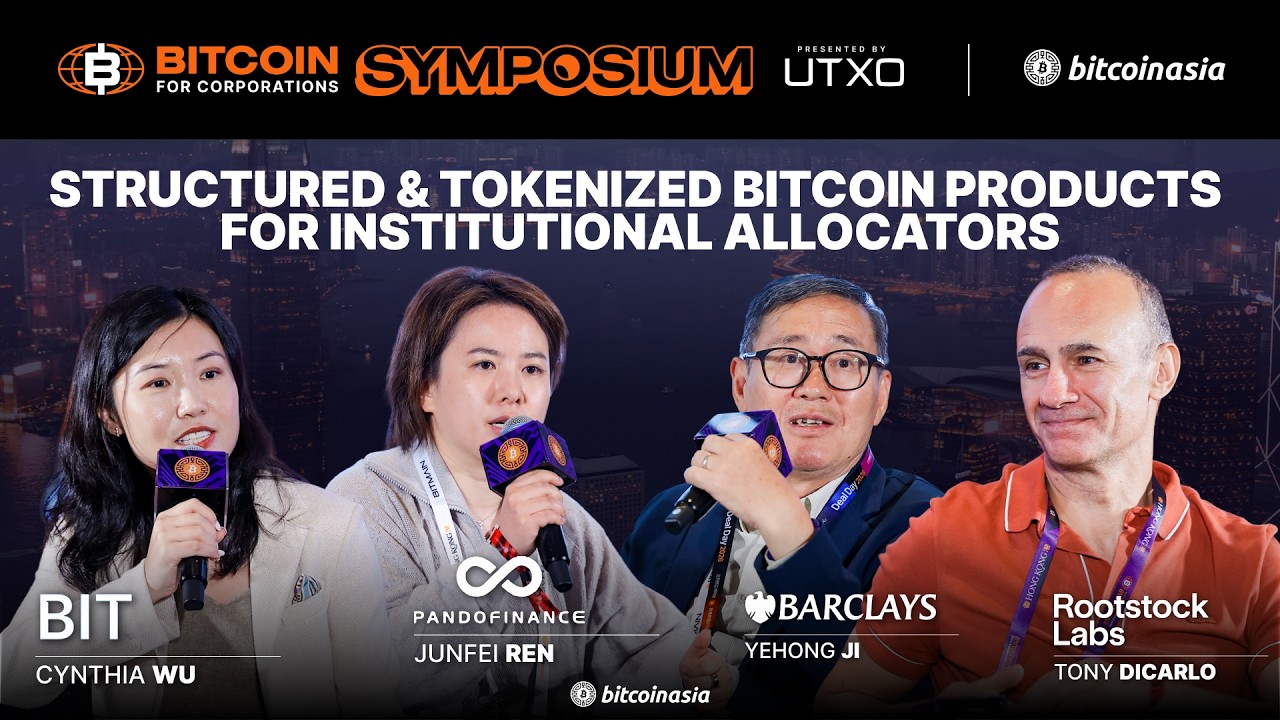
At Bitcoin Asia, Tony DiCarlo, Director of Structure Products at RootstockLabs, outlined a broader approach to Bitcoin monetization spanning lending, collateral, derivatives, structured products and onchain strategies. Institutions and businesses with Bitcoin on their balance sheets are increasingly exploring custody-first lending products, fund structures and proprietary hashrate strategies, with requirements around auditability, custody, jurisdiction and risk shaping how those products are structured.
Miner finance also became a more prominent part of that work. RootstockLabs has been exploring Bitcoin-denominated lending for miners and structures that pool miner loans into senior and junior tranches, bringing more familiar capital-markets frameworks into Bitcoin-native financing.
RootstockLabs also took these themes to the financial press. In The Block, Richard Green commented on Treasuries out-yielding the Bitcoin carry trade. In Sandmark, he looked at how the downturn was testing a changing lending market, and in Investor’s Business Daily he weighed in on ETF flows and the rally to $79,000. In September, Tony Dicarlo was quoted in Forbes and Crypto.news on where the market goes next.
Bitcoin-backed credit featured in discussions around corporate liquidity, treasury management and miner financing, while Bitcoin yield remained a recurring topic across institutional products and structured strategies.
Rather than focusing on headline returns, the conversation increasingly centered on how products are structured, what sits behind them and whether they can meet institutional requirements.
Japan provided another perspective on that shift. Moriki Kamio, Head of Japan at RootstockLabs, looked at the development of yen-denominated stablecoins, digital securities, Bitcoin treasury companies and the country’s evolving regulatory environment.
Together, those developments point toward a market where institutional Bitcoin activity is expanding beyond accumulation into broader financial infrastructure.
Taking Bitcoin-Secured Finance Into the Market
Q3 was also an active quarter for the RootstockLabs team across the institutional and Bitcoin events calendar.
- In July, the team attended Mining Disrupt in Miami, where mining economics, access to capital, energy markets and the growing move toward AI and high-performance computing were major themes.
- The team was also in Tokyo for WebX Asia, where institutional adoption, stablecoins and tokenized financial products featured prominently across the programme.
- August brought Blockchain.RIO, continuing RootstockLabs’ engagement with one of the most active digital-asset markets in Latin America and a region where tokenized credit and real-world assets are already gaining traction.

Later in the month, the team travelled to Hong Kong for Bitcoin Asia and Bitmain’s World Digital Mining Summit.
Tony Dicarlo joined a Bitcoin Asia panel on structured and tokenized Bitcoin products for institutional allocators alongside representatives from Pando Finance and Barclays.
The discussions across the week covered miner financing, Bitcoin yield, custody, structured products and the growing role of hashrate in institutional markets. Learn more.
Hashrate in particular featured more prominently in capital-markets conversations, as better benchmarks, financing structures and risk models create more ways for institutional participants to evaluate the economics behind Bitcoin mining.
September brought the team to London for Bitcoin Corporate Day.
Richard Green, Tony Dicarlo and Andrea Cosentino represented RootstockLabs at the event, where conversations covered corporate Bitcoin holdings, custody, lending, collateral, payments, liquidity and energy markets.
Across Miami, Tokyo, Rio, Hong Kong and London, many of the same themes continued to surface: how institutions use Bitcoin beyond simply holding it, how Bitcoin-backed products should be structured, and what infrastructure is needed to support larger pools of capital.
Ecosystem and Network Momentum
Activity across the wider Rootstock ecosystem also continued during Q3.
Mercado Bitcoin’s tokenized real-world assets on Rootstock approached $60 million during the quarter, up from the levels reported earlier in the year. The growth provides another example of Bitcoin-secured infrastructure being used for regulated financial assets, including tokenized private credit in Latin America.
Merged mining remained a central part of Rootstock’s security model. The Q2 2026 Merged Mining Insights Report, published during Q3, showed Rootstock averaging 809.63 EH/s of securing hashrate during the quarter, equivalent to 83.96% of Bitcoin’s total hashrate.
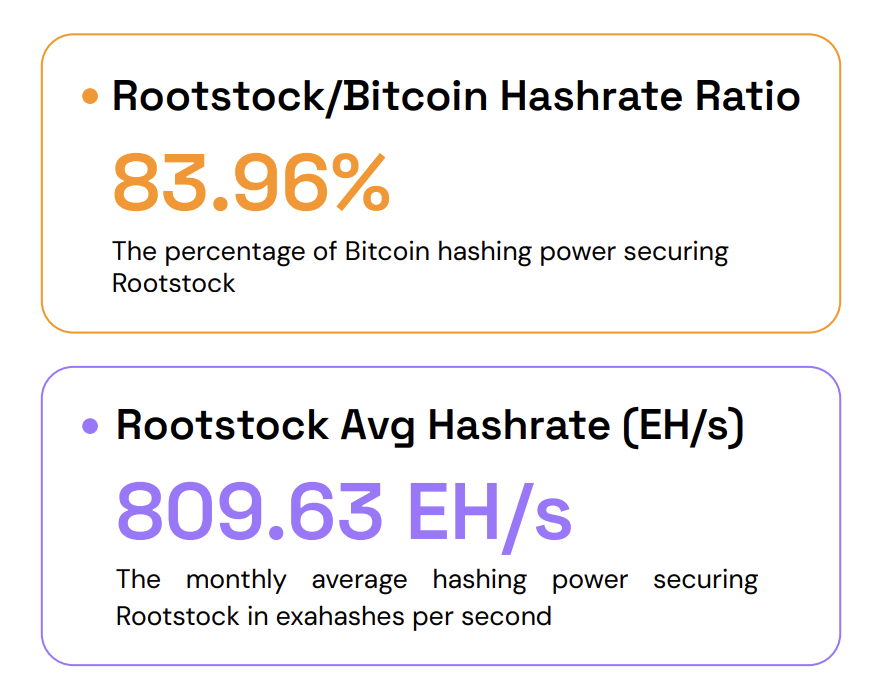
Merged-mining participation across the observed mining pools reached 93.73%. That continued participation means Rootstock remains closely tied to Bitcoin’s proof-of-work security while allowing miners to earn additional rewards without deploying separate mining infrastructure.
RootstockLabs also joined Bitcoin For Corporations during the quarter.
The membership connects RootstockLabs with a wider network focused on corporate Bitcoin adoption and the practical questions companies face around treasury strategy, infrastructure and the use of Bitcoin in business.
Advancing Rootstock’s Security and Infrastructure Roadmap
Rootstock’s 2026 roadmap also moved forward during the quarter.
- Institutional vaults form part of the roadmap, extending the infrastructure available for more structured Bitcoin deployment and treasury strategies.
- Work on Bitcoin interoperability also continued through Union Bridge and BitVMX, with the longer-term goal of reducing the trust assumptions involved in moving BTC between Bitcoin and Rootstock.
- On the protocol side, Parallel Transaction Execution is being developed to increase Rootstock’s capacity by allowing independent transactions to be processed simultaneously rather than sequentially.
Security remained another major area of work.
RootstockLabs Co-founder and Scientific Advisor Sergio Demian Lerner continued to outline Rootstock’s defence-in-depth approach, where network security is built around multiple independent layers rather than relying on any single mechanism.
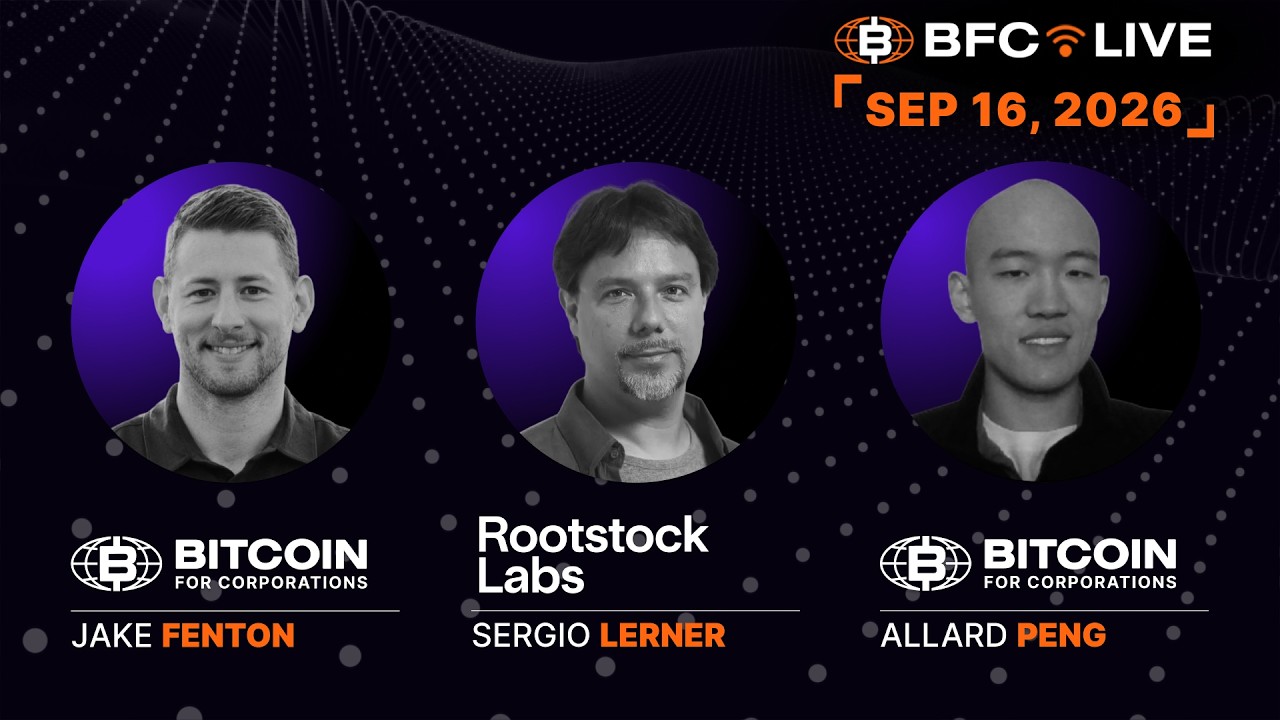
The PowPeg reflects this model through a combination of proof-of-work security, time delays, hardware-protected keys, independent validation and threshold participation. Learn more.
Further work is also underway around FACON, or Fork-Aware Consensus, which is designed to strengthen protection against hidden-fork attacks by moving detection into the protocol itself.
Longer-term planning includes preparation for potential post-quantum risks, with Rootstock contributors examining how the network can evolve if advances in quantum computing eventually threaten existing cryptographic assumptions.
Together, these initiatives are aimed at strengthening the infrastructure required as more financial activity moves onto Bitcoin-secured rails.
What Next in Q4
In October, Rootstock will publish its post-quantum roadmap, a phased plan to move the network to quantum-resistant cryptography before it’s ever urgent. In December, the Cardamom network upgrade is set to follow, with groundwork for smarter wallets, PowPeg bridge improvements and better compatibility with Ethereum tools.
We’ll also be on the road. We are currently at TOKEN2049 and will be at LABITCONF, at the end of October then head to Amsterdam on 5–6th November for the Bitcoin For Corporations Symposium and Bitcoin Amsterdam.
In between, on 31st October, as Bitcoin turns 18, we’re releasing new research on Bitcoin’s next chapter: what happens when institutions stop just holding it and start putting it to work.
Want these updates first? Subscribe to the RootstockLabs newsletter. Meeting us in Amsterdam or at LABITCONF? Book time with the team here.