Last week, Strategy bought 457 Bitcoin for $29.6 million. In the same week, it spent $211.8 million buying back its own preferred stock. For the company that built the Bitcoin treasury model, that ratio says a lot.
Strategy now holds 851,305 BTC at an average cost of $75,446. Bitcoin fell below $60,000 on November 20 for the first time since July. At around $61,000, those holdings are worth roughly $12 billion less than Strategy paid for them.
The pressure goes beyond one company. MSCI has announced it will remove Strategy, Metaplanet and Upexi from its indexes on November 30, the first deletions under its new rules for “non-operating” companies. And according to Blockworks data, 24 of the 25 largest crypto treasury companies now trade below the value of the assets they hold.
The market is asking harder questions about whether these business models can last. The answer depends on what treasury companies do next, not just on what Bitcoin does.
₿ Accumulation is not a balance sheet strategy
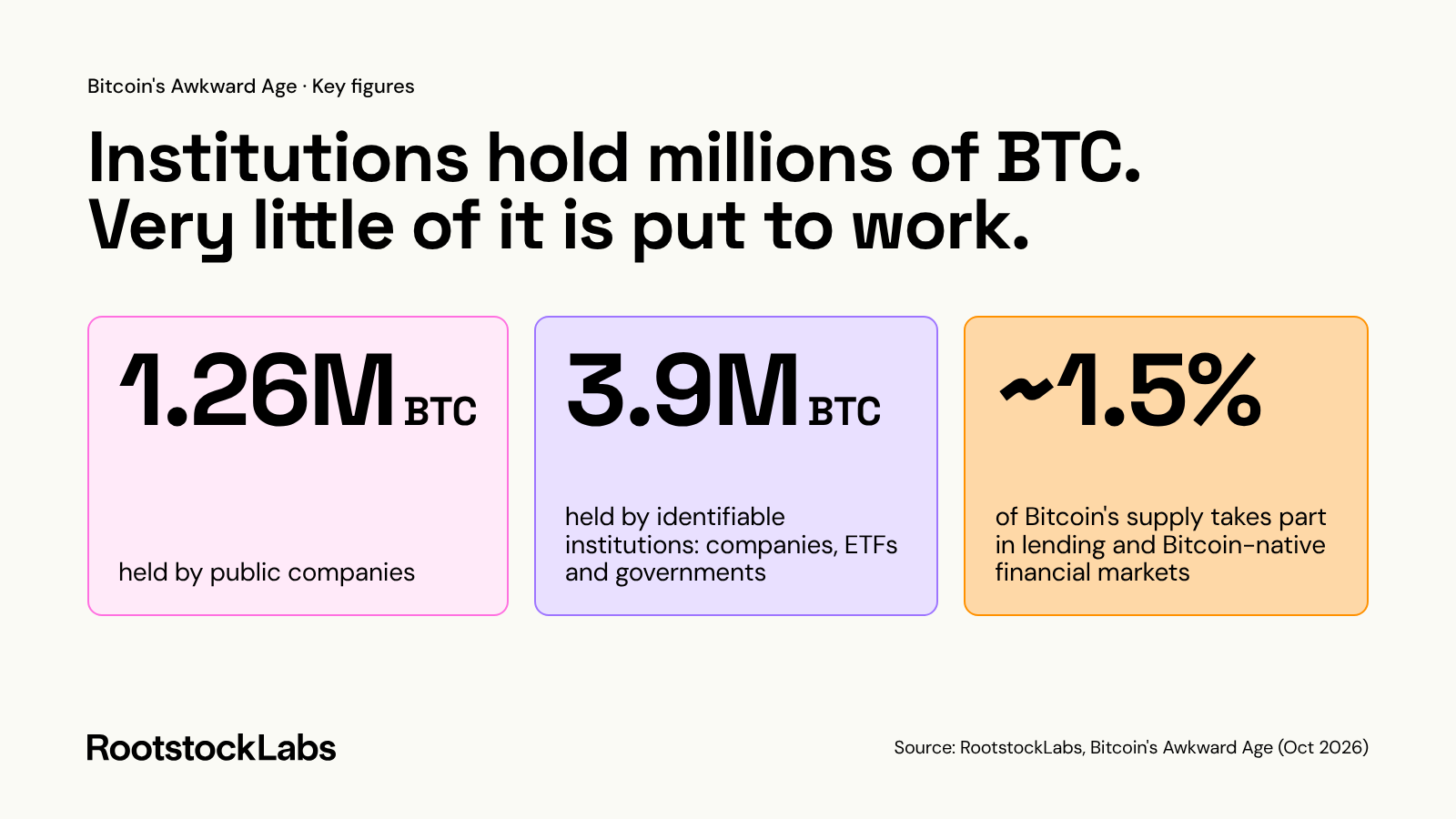
According to our recent institutional report, Bitcoin’s Awkward Age, public companies collectively hold approximately 1.26 million BTC. That’s a remarkable achievement for an asset less than two decades old. But as many in the industry already know, holding Bitcoin and managing a balance sheet built around it are different challenges.
When a treasury company trades at a significant premium to its holdings, issuing equity to buy more Bitcoin can be accretive to shareholders. When that premium disappears, the economics change. Raising capital gets harder, dilution becomes a bigger concern, and interest payments, preferred dividends and operating expenses all remain.
Bitcoin doesn’t need to recover by the end of the quarter. A company’s financial obligations, however, have deadlines.
₿ The economics behind the Bitcoin treasury trade
In Bitcoin’s Awkward Age, Tony Dicarlo, Director of Structured Products at RootstockLabs, examines what he calls productive liabilities: holding Bitcoin, with its long-term appreciation potential, against fiat-denominated financial obligations. The opportunity lies in the spread between Bitcoin’s long-term appreciation and the cost of fiat financing.
Strategy pioneered this model at scale through a combination of equity, convertible debt and preferred securities.
But Bitcoin’s appreciation is neither linear nor guaranteed. Financing costs can rise. Access to capital can dry up. A prolonged downturn exposes weaknesses that stay hidden during sustained rallies.
The question is not how much Bitcoin a company can accumulate in a bull market. It is how well it can manage its balance sheet through an entire cycle.
₿ How can a company earn yield on its Bitcoin treasury without selling it?
A company can earn Bitcoin-denominated income without selling by putting a portion of its reserves to work in institutional lending, collateral markets, liquidity provision or Bitcoin-native financial protocols, while keeping ownership of the underlying BTC.
Treasury companies have spent years optimising the liability side of their balance sheets. Far less attention has gone to the asset side.
Bitcoin, unlike bonds or income-generating equities, does not inherently produce income. For most of its history, investors accepted that trade-off in exchange for scarcity and long-term appreciation. As Bitcoin matures, that may change.
Institutional lending, collateral markets, liquidity provision and Bitcoin-native financial protocols are creating ways for holders to earn returns on a portion of their reserves. Those returns come from real demand: borrowers who need Bitcoin liquidity, markets that pay for collateral, and protocols that reward capital put to work.
For a treasury company, carefully managed strategies could potentially:
- Offset custody, insurance and operational costs.
- Generate income to support financial obligations.
- Reduce reliance on external capital markets.
- Accumulate additional BTC through Bitcoin-denominated returns.
There’s a structural angle too. MSCI’s decision turned on whether these companies are operating businesses or passive holding vehicles. A treasury that actively manages its reserves looks very different from one that simply waits for the price to rise.
₿ Where does Bitcoin yield come from, and is it safe?
Bitcoin yield is only as safe as its source. Sustainable yield comes from real demand, such as borrowers paying for Bitcoin liquidity or markets paying for collateral, through structures institutions can see and verify. For more detail, see where Bitcoin yield comes from.
Any institution considering Bitcoin yield will remember 2022.
Celsius, BlockFi and Genesis offered attractive returns on Bitcoin, and all three collapsed. The problems were not unique to Bitcoin. They were the oldest failures in finance: opaque counterparties, customer assets lent out again without clear disclosure, short-term liabilities funding long-term or illiquid positions, and returns that no one outside could audit.
The lesson is not that Bitcoin can’t be productive. It’s that returns must come from sources institutions can see and verify. The question to ask of any Bitcoin yield strategy is not “how much?” but “from where, against what risk, and can I check?”
Five checks for any Bitcoin yield strategy:
- Source: who pays the return, and why?
- Counterparty: who holds the Bitcoin, and what happens if they fail?
- Reuse: is the Bitcoin lent on again (rehypothecated), and is that disclosed?
- Liquidity: do withdrawal terms match how long the capital is tied up?
- Verification: can you check positions and collateral yourself, on chain or through an independent audit?
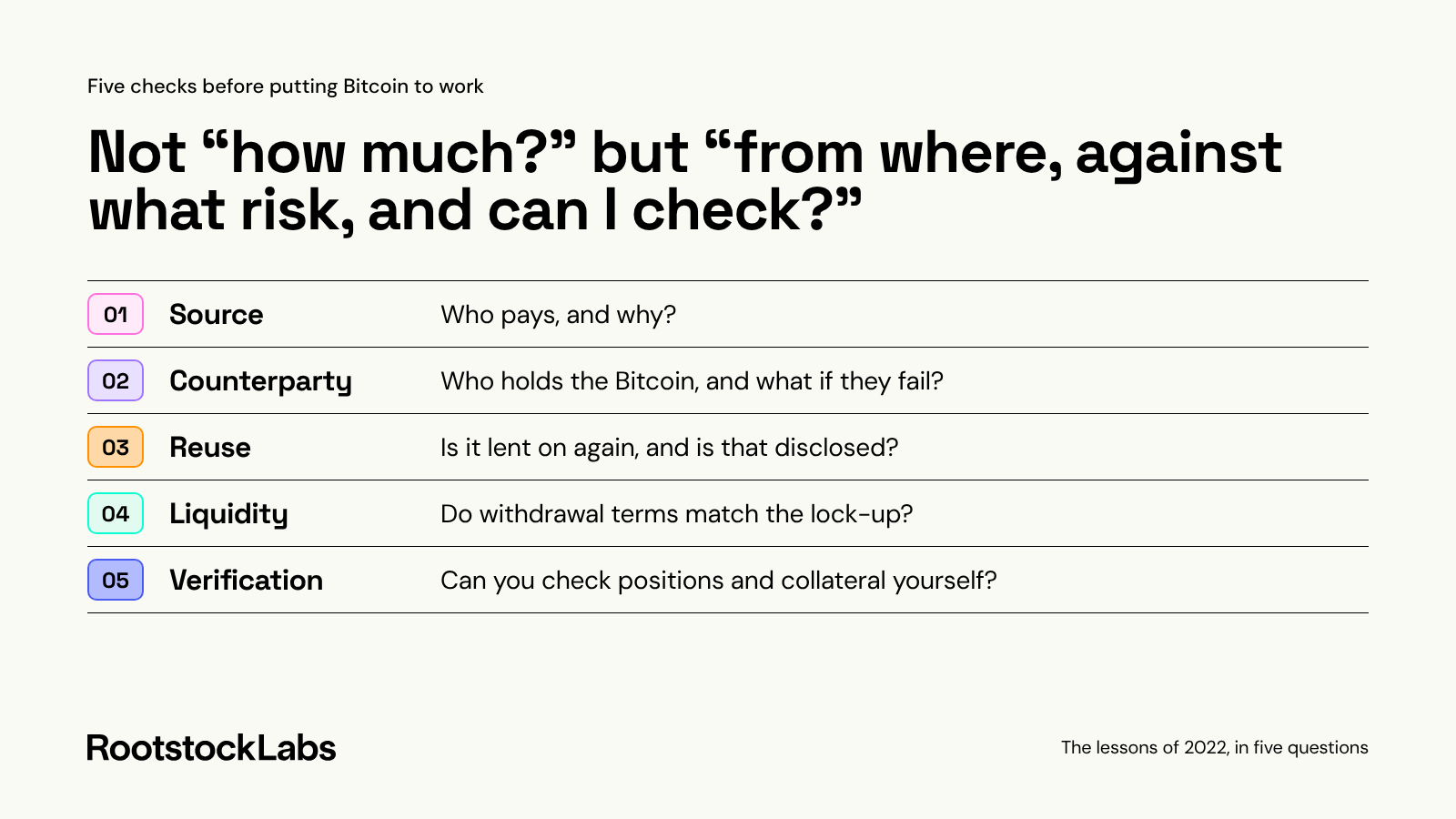
Not “how much?” but “from where, against what risk, and can I check?” The lessons of 2022 in five questions. Source: RootstockLabs.
₿ A largely untapped opportunity
Our research estimates that identifiable institutions, including public and private companies, ETFs and governments, collectively hold approximately 3.9 million BTC. Yet only around 1.5% of Bitcoin’s supply takes part in lending and Bitcoin-native financial markets.
Consider an illustrative scenario. If just 5% of identifiable institutional holdings earned a 5% annual BTC-denominated return, that would be 9,750 BTC a year. If institutional holdings doubled, the same assumptions would produce 19,500 BTC a year.
These are illustrative scenarios, not forecasts or guaranteed returns. But they show the potential scale of a financial economy still in its infancy.
Key figures from Bitcoin’s Awkward Age (RootstockLabs, October 2026):
- Public companies hold approximately 1.26 million BTC.
- Identifiable institutions, including public and private companies, ETFs and governments, hold approximately 3.9 million BTC.
- Only around 1.5% of Bitcoin’s supply takes part in lending and Bitcoin-native financial markets.
₿ The next phase of Bitcoin treasury management
Building financial utility around established assets is hardly new. Government bonds became the foundation of repo markets. Equities evolved into securities lending and structured finance. Gold developed extensive collateral, leasing and derivatives markets.
None of these assets had to give up its original investment characteristics to become more useful. Neither does Bitcoin.
That requires infrastructure built around institutional expectations: transparent sources of return, robust risk management, auditable financial structures and predictable liquidity. In other words, the opposite of 2022.
RootstockLabs builds Bitcoin-secured financial infrastructure on Rootstock, the Bitcoin sidechain secured by merge-mining with over 80% of Bitcoin’s hashrate, so institutions can put Bitcoin to work with positions and collateral they can verify on chain.
The objective is not to chase the highest yield. It is to make long-term Bitcoin ownership more productive without taking on disproportionate risk.
₿ Bitcoin treasury, beyond accumulation
This downturn may ultimately separate companies that simply accumulated Bitcoin from those able to build sustainable financial models around it. Bitcoin treasury companies were among the first to show how a permanently scarce monetary asset could fit into traditional capital structures. They are unlikely to be the last. The next generation of treasury management will be defined not just by how much Bitcoin a company holds, but by how well it manages assets and liabilities together.
Bitcoin’s first era established its monetary identity. Its next may be defined by the financial utility built on top of it.
₿ FAQ
Can a Bitcoin treasury company earn income without selling its Bitcoin?
Yes. It can put a portion of its reserves to work through institutional lending, collateral markets, liquidity provision or Bitcoin-native protocols, and earn Bitcoin-denominated income while keeping ownership of its BTC.
Where does Bitcoin yield come from?
From real demand: borrowers who need Bitcoin liquidity, markets that pay for collateral, and protocols that reward capital put to work. If the source isn’t clear, the yield isn’t safe.
How should an institution assess the risk in a Bitcoin yield product?
Check the source of the return, the counterparty, whether assets are reused, whether liquidity terms match the commitment, and whether positions can be independently verified.
What is RootstockLabs?
RootstockLabs builds Bitcoin-secured financial infrastructure for institutions on Rootstock, the Bitcoin sidechain secured by merge-mining with over 80% of Bitcoin’s hashrate. The RootstockLabs institutional team helps exchanges, Bitcoin treasury companies, miners and family offices make their Bitcoin productive, with structures they can see, understand and verify.
Explore the economics of productive Bitcoin assets, liability management and the next phase of institutional adoption in our latest research report: Bitcoin’s Awkward Age: How financial utility broadens structural demand on a fixed supply asset.