Welcome to the November issue of Bitcoin Forward, RootstockLabs’ institutional Bitcoin newsletter. This month Bitcoin fell below $60,000, US spot ETFs recorded their worst month since launch, and MSCI confirmed it will remove Strategy from its indexes. It was the hardest test yet for the institutional Bitcoin trade. But the infrastructure underneath kept being built: Deutsche Bank went live with Bitcoin custody, and the network kept running exactly as designed.
The short version
- The pressure came from macro and flows, not the protocol. A hawkish Fed, sticky inflation and a tech sell-off pushed investors out of risk assets, and Bitcoin went with them.
- The treasury trade is being repriced. Strategy’s holdings are now worth less than it paid for them, and 24 of the 25 largest treasury companies trade below the value of their assets.
- Institutions kept building. Deutsche Bank’s custody launch shows bank-grade Bitcoin infrastructure moving forward through a downturn.
In this issue
- Bitcoin falls below $60,000
- A record month for ETF outflows
- MSCI, Strategy and the treasury trade
- Deutsche Bank goes live
- Miners feel the squeeze
- What November did to a BTC-backed loan
- Market data and signals
- What to watch
₿ Bitcoin falls below $60,000
Bitcoin started November near $80,000. On November 20 it fell below $60,000 for the first time since July, and by November 25 it was trading around $59,000. That’s down roughly a quarter in a month and more than 50% below its all-time high of about $126,000 from October 2025.

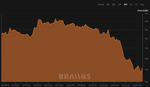
Last month we said the sell-off was a macro story, not a Bitcoin-specific one. November confirmed it. Inflation stayed above target, futures markets now price a December rate hike as near-certain, and a sharp sell-off in tech stocks pulled risk assets lower across the board.
When rates are expected to rise and risk appetite falls, allocators sell what’s liquid first. Bitcoin is one of the most liquid assets in any portfolio.
₿ A record month for ETF outflows
Close to $5 billion left US spot Bitcoin ETFs in November, beating June’s record of about $4.5 billion. BlackRock’s IBIT accounted for most of the withdrawals.
ETFs have been one of Bitcoin’s steadiest sources of demand. When that demand turns into selling, it shows up directly in price.
But look at who’s still holding. Galaxy Research’s analysis of Q3 13F filings shows institutional ETF holdings hit a record 356,491 BTC at the end of September. More important is who holds them. Wealth advisors now account for 40.5% of institutional ETF shares, the highest share since the funds launched, and have been net buyers for nine straight quarters. Wells Fargo became the largest single holder, passing Jane Street and Millennium. It’s the first time a wealth platform has ranked first. Hedge funds, many running short-term basis trades, fell from 50.6% of holdings at the end of 2024 to 19%.
November’s outflows are real, and Galaxy notes the picture has changed since September. But the base of holders is shifting from fast-moving trading funds toward the advisors who manage long-term client wealth.
Why it matters: outflows show allocators cutting risk. The holder data shows who’s building Bitcoin into long-term portfolios. Both can be true at once.
₿ MSCI, Strategy and the treasury trade
MSCI confirmed that Strategy, Metaplanet and Upexi will be removed from its indexes on November 30. They are the first removals under its new rules for “non-operating” companies. Index funds will have to sell their shares, with estimates for Strategy alone ranging from $1.5 billion to $2.8 billion. The removal doesn’t force Strategy to sell any Bitcoin.
Strategy kept buying every week of November, adding nearly 2,000 BTC. It now holds 851,305 BTC at an average cost of $75,446. With Bitcoin around $60,000, those holdings are worth roughly $12 billion less than Strategy paid for them.
One week tells the story. Strategy bought 457 BTC for $29.6 million and, in the same week, spent $211.8 million buying back its own preferred stock.
Strategy isn’t alone. 24 of the 25 largest crypto treasury companies now trade below the value of the assets they hold, according to Blockworks data.
Last month we asked readers whether Saylor’s Bitcoin playbook is still worth copying. November turned that question into a live test. When a company’s only strategy is to raise capital and buy Bitcoin, falling prices hit both sides at once: the value of what it holds and its ability to raise more.
Why it matters: treasury companies have spent years engineering the liability side of their balance sheets. The asset side has mostly sat idle. The next phase is making held Bitcoin productive without taking on risks that force a sale in the next drawdown. Read more.
₿ Deutsche Bank goes live
In October, Deutsche Bank said its Bitcoin custody service was weeks away. In November it launched. Corporate and institutional clients in Europe can now hold Bitcoin, Ether and selected stablecoins with the bank, and its asset management arm is planning tokenized funds on the same platform.
For many institutions, the custodian is the gate. Pension funds, insurers and asset managers can often only hold assets with a bank or qualified custodian. A launch by Germany’s largest bank, in the middle of a sell-off, widens the group of institutions that can hold Bitcoin directly.
₿ Miners feel the squeeze
Bitcoin’s mining difficulty fell 9.1% in mid-November, its biggest drop since 2021. Difficulty tracks how much computing power is competing to mine blocks. A fall this large means a meaningful share of machines were switched off as the lower price pushed them below break-even. Some miners are also moving capacity into AI computing, where revenue is steadier.


This is the network working as designed. When miners leave, difficulty falls and the miners who stay earn more per unit of computing power. Blocks keep arriving roughly every ten minutes, whatever the price.
Why it matters: miners earn in Bitcoin but pay most of their costs in dollars. In a month like this, financing against BTC or hashrate is what lets a miner keep running without selling at the bottom.
₿ What November did to a BTC-backed loan
Last month we worked through an example loan. A treasury company pledged 1,000 BTC at about $86,000 and borrowed $43 million, a 50% loan-to-value (LTV). We assumed a margin call at 70% LTV and liquidation at 80%.
| BTC price | Collateral value | LTV | Status |
|---|---|---|---|
| $86,000 (early October) | $86.0M | 50.0% | Opening position |
| $80,000 (end of October) | $80.0M | 53.8% | Comfortable |
| $61,430 | $61.4M | 70.0% | Margin call |
| $59,000 (November 25) | $59.0M | 72.9% | Past the margin call |
| $53,750 | $53.8M | 80.0% | Liquidation |
In October that loan had plenty of room. By late November it was past its margin call, and the borrower would have had to post more collateral or repay part of the loan. A borrower who started at 30% LTV would still be comfortably below 45%.
The lesson isn’t that borrowing against Bitcoin is too risky. Starting LTV, margin call levels and the time you get to respond decide whether a month like November is one you watch or one you have to act in.
Figures are illustrative and rounded. Thresholds vary by lender and loan agreement.
₿ Market data and signals
- Mining difficulty fell 9.1%, the biggest drop since 2021, as lower prices pushed miners offline.
- BTC is more than 50% below its all-time high. It’s the deepest drawdown since the ETFs launched.
- Close to $5B left US spot ETFs, a record month.
- Strategy now trades close to the value of its Bitcoin, removing the premium that funded its buying.
- Only about 1.5% of Bitcoin’s supply is used in lending and Bitcoin-native markets. Most institutional BTC still sits idle.
₿ What to watch
- November 30: MSCI index removals take effect for Strategy, Metaplanet and Upexi.
- December 8–9: Fed meeting. A hike is widely expected.
- ETF flows: a turn back to inflows would be the first sign allocators are returning.
- Treasury companies: watch for more buybacks, asset sales or moves to generate yield on held BTC.
₿ The Deep Dive: Bitcoin’s Awkward Age

Weak prices don’t mean decline. In our new report, Tony DiCarlo argues Bitcoin is in an awkward age between store of value and financial infrastructure, and that financial utility could unlock a second source of demand on a fixed-supply asset. In one illustrative scenario, if Bitcoin played even a 1% role in global financing, that would be $5.6T.
₿ From our vault
Could a quantum computer break Bitcoin?
Quantum computing is one of the most discussed risks in Bitcoin right now. Our researcher Nicolas separates the real risk from the hype, and explains how Rootstock is preparing long before it’s urgent. Read more.
Can the Bitcoin treasury trade survive sub-$60K Bitcoin?
The playbook was accumulation. The next phase is making held BTC productive, safely. We set out five checks for any Bitcoin yield strategy. Here’s more on this.
₿ Notes from Bitcoin Amsterdam


A few years ago, Bitcoin conferences were full of early adopters. At Bitcoin Amsterdam this year, Sam Golden, VP Marketing at RootstockLabs, met Big Four accountants, analysts from major banks, and billion-dollar family offices holding most of their wealth in Bitcoin. His takeaway: Bitcoin is reaching the “early majority”, the pragmatists who judge it on infrastructure, reliability and support, not belief. Read Sam’s takeaways.
Get Bitcoin Forward in your inbox
One institutional briefing a month. No noise. Subscribe.
This briefing is for information only and is not investment, legal or tax advice.